
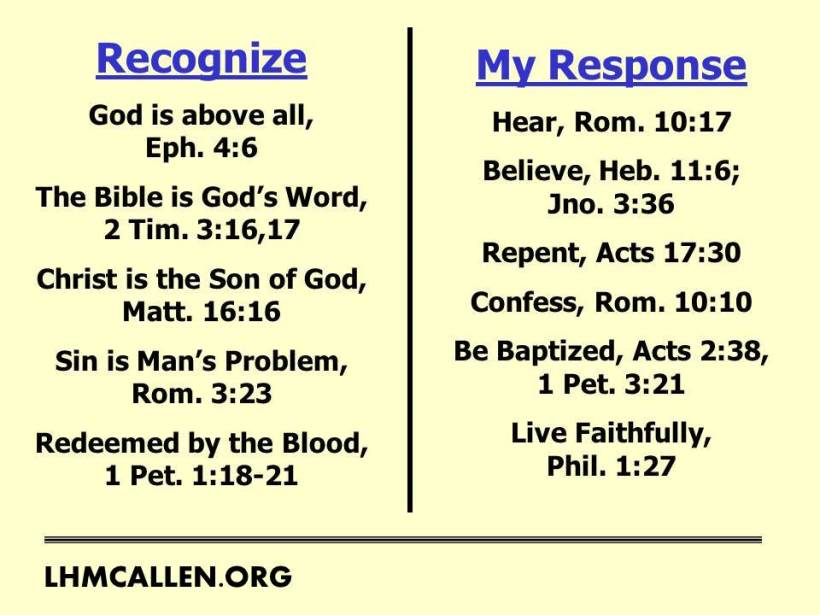
Your Response Invited
FAITH, HOPE AND LOVE
by Jay Bowman
We give thanks to God always for you all, making mention of you in our prayers, remembering without ceasing your work of faith, labor of love, and patience of hope in our Lord Jesus Christ in the sight of our God and Father knowing, beloved brethren, your election by God. I Thess. 1:2-4 NKJV
Paul begins this epistle with a warm commendation of the Thessalonian Christians. They were always on his mind. They were always in his prayers. Paul had had some very anxious times in Thessalonica (see Acts 17:1-9). This might cause a man of less noble character to put them out of his mind, to close the book on the city and its people. That is often the result when one has unpleasant experiences in a place. But, Paul remembered them continuously and with much pleasure. He gave thanks for them before God’s throne.
WORK OF FAITH
He remembers without ceasing their “work of faith”, i.e. their work that faith produced. Faith is the basis of everything we do. It is more than a passing acknowledgement of Christ’s deity, more than a brief confession of His lordship. The word “faith” has been vastly changed in the hands of Calvinistic teachers.
It did not mean to believe something without evidence. To the contrary, the word in the plural is often translated “the proofs”, that is the evidence, the things that inspire confidence. It expressed a high degree of confidence based on strong evidence.
Faith without works is really a contradiction of terms. But for the desire to enjoy faith’s benefits without labor’s weariness, such a thing would never be contemplated. Faith and inactivity are direct opposites.
This is true because God requires us to be active. He created us for activity (Eph. 2:10). One example of the Thessalonians’ activity was that they “sounded forth” the word not only in Macedonia and Achaia but also “in every place”. Their faith had produced this.
Faith always produces works. Works are therefore a pretty good measure of one’s faith. If you want to know how much faith a man has, look at what he does.
LABOR OF LOVE
Labor is distinguished from work in that labor is difficult work. It is wearisome toil. “Work” is the more general term; labor, more specific. Work may be pleasant or unpleasant. Labor is troublesome and dreary.
But, love makes toil more bearable. Jacob served seven years for his wife, Rachel (Gen. 29:20). It was hard work. Yet, it “seemed but a few days because of the love he had for her”. Love makes labor more bearable, and the time passes faster. The Thessalonians had received the word in much affliction. Their job was difficult from the beginning. But, they could tolerate the difficulty because of the “joy” they felt (v.6). Love renders even difficult things joyous.
PATIENCE OF HOPE
“Patience” means the ability to hold out under stress. The word Paul used means “remaining under” or “remaining absolutely.” that is, digging in and holding out, staying power under difficulty. Hope makes it possible to hold out under stress. Hope is the vivid. This is about expectation of success of relief, of reward. When the human mind, filled with joy and love, projects itself into the future, partaking of the bliss and honor due to the faithful, this hope makes difficulty more bearable. The Thessalonians concentrated not on the miseries of the moment but on the rewards of the future. Their vivid hope inspired a commendable endurance. “Patience” (endurance) grows out of hope. Hopeful Christians can summon courage, persistence and strength that others, less hopeful, never know.
But, when hope goes, endurance goes. People who lose hope lose their courage. Faith is the basis of what we hope for (Heb. 11:1). So the word of God is the source of hope. The Bible (Rom. 10:17) provides first faith and love, then endurance and joy, then persistence in good works.
Originally From – NORTH PARK CHURCH OF CHRIST
June 22, 1983
Abilene, Tx.
Now Published in the book – JAY BOWMAN, THE COLLECTED WORKS (Amazon, Barnes & Noble)
“Honor Your Father and Mother”
(Exodus 20:12)
Pat Jones
When I walk through nursing homes and see the halls of elderly men and women in various stages of deterioration, I wonder how many have families who care. As I look on their faces, hungry for attention, I think of the fifth of the Ten Commandments, “Honor your father and your mother” (Exodus 20:12) which was repeated to the Jews by Jesus (Matthew 15:4) and was re-taught to Christians by Paul (Ephesians 6:2). Honoring your parents involves several biblical principles.
Honor your father and mother in youth by respecting your parent’s authority. Ephesians 6:1–3 says, “Children, obey your parents in the Lord: for this is right. Honor your father and mother, which is the first commandment with promise: that it may be well with you and you may live long on the earth.” The breakdown of authority that is creating chaos in our streets and schools generates from a failure to learn respect for the authority of father and mother (Romans 1:30; 2 Timothy 3:2).
Honor your father and mother by living the wisdom they taught you. “A wise son makes a glad father, but a foolish son is the grief of his mother” (Proverbs 10:1). Timothy was a great example of a grown man who honored the wise teaching of his mother and grandmother (2 Timothy 1:5; 3:14–15).
Honor your father and mother by meeting their physical needs. As He suffered on the cross, Jesus made provision for His mother’s welfare (John 19:26–27). Paul exhorted children and grandchildren, “Let them first learn to show piety at home and to repay their parents; for this is good and acceptable before God” (1 Timothy 5:4). Jesus criticized the Pharisees who neglected their parents’ needs, claiming their money was dedicated to God (Mark 7:10–12). How much more under condemnation will children be who neglect parents out of selfishness? Such makes them worse than infidels (1 Timothy 5:8).
Honor your father and mother by respecting the difficulties that age has brought them (Ecclesiastes 12:1–5). Be patient with their frailties. Remember these people fed you, changed your diaper, carried you about, and rose up in the night when you cried. They worried over your childhood illnesses, put up with your immaturity, and paid your bills for almost 20 years. If their age brings some burdens to you, consider it as a long overdue repayment.
Honor your father and mother by seeing that their emotional needs are met. “Do not despise your mother when she is old” (Proverbs 23:22). Elderly parents go through the pain of watching as one-by-one their friends and family members die. The day comes when death separates your father and mother, and one is left alone. Are you there for them in those days of loneliness? Do you continue to let them know how important they are to you?
“The tender words unspoken
The letters never sent
The long forgotten messages
The wealth of love unspent
For these some hearts are breaking,
For these some loved ones wait,
So show them that you care for them
Before it is too late.”
As we look, not only at our parents, but at all the elderly, let’s remember one day (if we live) we will be in their shoes, crippled with the pains of old age, longing for companionship.
Someone has written …
“We are the old folks that you see
Who fast to life have clung,
And like us you will someday be,
For once we too were young.
We now are in life’s aftermath,
And by the grace of God
Your feet will travel o’er the path
Our weary feet have trod.
The things we should remember
Slip by us, just like time,
Our flame is now an ember,
And our efforts not in rhyme.
So treat us kindly as you pass.
And as your days unfold
Remember, time is going fast …
You, too, are growing old!”
“Rise up before the grey-headed, and honor the face of the aged …” (Leviticus 19:32).
Jones, P. (1994). “Honor Your Father and Mother” (Exodus 20:12). In M. White (Ed.), Christianity Magazine: July 1994, Volume 11, Number 6 (M. White, Ed.) (15). Jacksonville, FL: Christianity Magazine.
Interview – Ralph Walker On Grandparenting
Pressing On Magazine, Oct. 2013
1. What valuable memories do you have of your grandparents?
Spiritually speaking, they are a bit one-sided. My father’s parents were active in a denomination, but I do have vivid memories of my grandmother, who was a self-taught pianist, playing hymns on her upright and singing along with them, just for herself, it seemed to my child’s mind. My father learned about NT Christianity from my mother before they married. Her parents were very active in the Lord’s church in Pensacola, FL. Since my mother came from a large family, getting everyone to services when we had family reunions was like organizing a military invasion. But I have sharp memories of all of us occupying pews in worship together – a block of them I think, my grandmother always in a pillbox-type hat. And she loved to sing, though she didn’t have a great ear for pitch. She did love to hear her grandchildren sing for her whenever we learned new songs. I realize how important those memories are in my life, and I want my grandchildren to have similar memories of Paula and me.
2. When you realized you were going to be a grandparent, what were your first thoughts?
My oldest daughter was married a couple of years when they announced they were expecting. I think my earliest thoughts were that I was too young to be a grandfather (49) and she was too young to be a mother. They lived away from us and we thought they would need lots of help. They didn’t.
3. Describe some of the special events, traditions you and your wife have set up for your grandchildren.
Whenever the grandkids who live away are home, we love to read aloud to them. And we always try to have family singings and devotions together. Of course we sit together for worship, which is a great blessing for Paula and me. We have two sets of grandchildren who live here. I think we sacrifice the special efforts to share devotional times with them for the exchange of familiar times with them. My oldest grandchild was saved this year and I want to remember her “rebirthday” every year, as I have consistently remembered my daughters rebirthdays (the day they surrendered their lives to Jesus) with a special card and reminding them how old they are in spiritual years.
4. What are some of the typical mistakes Christian grandparents need to be aware of?
Not deliberately focusing on spiritual lessons. We can be that way with our own children, too. Taking advantage of the moments to share some beautiful thought about our Lord or the Word is redeeming the time, I think.
Not being a disciplinary force in their lives, but being the mushy-love figures. I don’t want to wait until I’m upset to exercise discipline. I need them to know me as an authority figure who loves them, but demands obedience too.
5. How do you navigate the relationship of being a grandparent, without intruding into the realm of parental oversight?
Paula and I try to maintain an advisory-on-demand relationship. We really have to work at not offering counsel or opinions which are not asked for, but I think that is generally the best course of action. The exception would be when you see children making serious mistakes or judgments, in which case an unrequested intervention might have to take place. I believe those are welcome if they don’t occur too frequently.
6. How are grandparents today generally different from grandparents in the former generation?
I recall my grandparents being very willing to be disciplinarians. They didn’t hesitate to correct us, even when my parents were in the room. My own parents were much less likely to do that with my own children. I don’t know if that is more attributable to the times or to individual character traits. I’ve noticed actions by other current grandparents I like a lot. We’ve taken our grandchildren for a week at a time and love the deeper relationship that allows. But I remember doing that with my own grandparents. But Grandparent Camp, in which some or all of the grandkids descend on the grandparents’ home for a week of fun and instruction, seems such a new idea to us. When we get the nerve, we’re going to attempt that one.
7. How does the role of grandparent change as the little ones become teens and young adults?
Well, we aren’t there yet. Our oldest grandchild is 10. But I think the challenge we will have is that of all grandparents (and even parents) – keeping relevant in their lives as they move into the “I know everything and I don’t really like anyone” years. There is a reason you don’t find “Grandparent Day” in the Junior High and High Schools. We want to do what we can to stay involved without alienating the teens. I know our parents were pretty successful in keeping good relations with our girls as they entered those teen years. They didn’t do it by trying to be their pals, but maintained a nobility with them. They demanded respect and yet were kind to give them space for their privacy and opinions.
8. Is the priority seeing our children and grandchildren become God’s children?
Absolutely. My daughters gave me a framed picture of Paula and me and the then current batch of grandkids with the passage from Psalm 78:67. It sits on my desk at all times, reminding me “that the generations to come might know, even the children yet to be born, that they should put their confidence in God and not forget the works of God, but keep His commandments.”
When I was working at FC, one of my duties and privileges was to speak to the incoming class’s parents at an orientation session. I always chose for my devotion with them Psalm 127. While I tried to stress various lessons for these parents letting their children go for the first time, the main one was the value of an arrow to extend our influence and power beyond our own reach. An arrow carries our desire far beyond our bodies.
Our children and grandchildren have been told and will continue to be told that we want them to carry the banner the Walker family has hoisted for Christ Jesus, and we want them to plant it higher on the hills of life than we were able to plant it. Hopefully they will all become powerful extensions of our own work for the Lord, and do more, go farther and penetrate the darkness more effectively than Paula and I could ever do ourselves. That is our plan, with the help and grace of God.
An irritable brother who always kept some grievance or issue loaded, called a meeting with the preacher and four elders of the local church he belonged to.
He leaped right into his complaint, arguing that all five brethren made a good living, drove late model cars and lived in nice homes, yet, he argued: “You don’t ever share your good fortune.” His audience listened patiently and then after the outburst, one of the elders said: “How do you know we do not share?” There was no answer. Apparently the agitated brother assumed they didn’t, or wanted to believe they were miserly. The elder calmly explained, putting an end to the event: “God does not expect us to prove to you or to anyone the extent of our benevolence. In fact, the larger amount of one’s benevolence will not be known. In support of this, he read Matt. 6:1-4, and the meeting ended.”
The story illustrates, among other things, a common misunderstanding of individual benevolence. The purpose is not to satisfy witnesses, elicit the applause of men, or prove anything to distractors. One’s sharing ought to be so private and unpublicized, when the right hand gives, the left hand has no idea. It should be as Harriet Beecher Stowe once wrote of someone she believed had the spirit of Jesus. She said of this person, that “He had a habit of quiet benevolence,” doing more good silently than was common of most people in their public charity. {Life and Letters of Harriet Beecher Stowe, 1897}
I read one time of a mystery unfolding in the world of college fundraising. “During the past few weeks, at least nine universities have received gifts totaling more than $45 million, and the schools had to promise not to try to find out the giver’s identity,” (AP, Apr. 16, 2009). I have no idea how this story will develop over the future. It may turn out that some individual or group of individuals are engaged in quiet benevolence, determined to avoid the typical praise of public, ostentatious giving. I hope so. Nevertheless . . .
I don’t know so much about “random acts of kindness,” but I’m entirely convinced of the value of quiet benevolence. Are you a quiet giver? There is rich spiritual value in this kind of giving. Value for you and the recipient, and “with such sacrifices, God is well pleased,” (Heb. 13:16).
Listen to Jesus again:
“Take heed that you do not do your charitable deeds before men, to be seen by them. Otherwise you have no reward from your Father in heaven. Therefore, when you do a charitable deed, do not sound a trumpet before you as the hypocrites do in the synagogues and in the streets, that they may have glory from men. Assuredly, I say to you, they have their reward. But when you do a charitable deed, do not let your left hand know what your right hand is doing, that your charitable deed may be in secret; and your Father who sees in secret will Himself reward you openly.” Matt. 6:1-4
A few years ago I enjoyed the recreational pursuit of riding a horse through a beautiful Ozark mountain trail. I’m not an experienced horse rider. The experience to navigate the steep, rocky trail belonged to the horse, not the rider. The horses available at West Mountain Trails were raised and trained for nothing but carrying inexperienced tourists through the mountain trails near Devil’s Den, Arkansas.
There is a purpose in all the equipment the horse wears, like the bit. Even the inexperienced rider can learn quickly to use the reins and bit to guide this powerful animal. As well trained as the trail horses are, you can actually lead them away from the familiar path, if you know how to use the equipment. While the bit is a very small instrument in proportion to the animal, it holds great power.
This is like the human tongue. One of the smallest members of the human body, but what great power it holds for good or evil! One false accusation can arouse suspicion about an innocent person – suspicion that will never really go away (though no sin may have been committed). One lie can hurt a whole family; one false doctrine can destroy a soul; one insult can discourage a struggling young person; one angry word can divide a church. And, when you read all of this, plug in the modern keyboard and internet!
“For we all stumble in many things. If anyone does not stumble in word, he is a perfect man, able also to bridle the whole body. Indeed, we put bits in horses’ mouths that they may obey us, and we turn their whole body . . . Even so the tongue is a little member and boasts great things. See how great a forest a little fire kindles . . . no man can tame the tongue. It is an unruly evil, full of deadly poison,” (James 3:2,3,5,8). “If anyone among you thinks he is religious, and does not bridle his tongue but deceives his own heart, this one’s religion is useless,” (James 1:26).
– From Pressing On Magazine, Jan. 2015, Click Here To Subscribe
“I said in my heart, ‘Come I will test you with mirth; therefore enjoy pleasure’; but surely, this also was vanity. I said of laughter—‘Madness!’; and of mirth, ‘What does it accomplish?’ ” (Ecclesiastes 2:1, 2).
Solomon, his failed experiment with wisdom having been recounted, now tells of a similarly empty attempt to find contentment in pleasure. From the discipline of careful thought he turns first to a passionate pursuit of the sensual. He pours himself into every activity pleasing to the senses, bombarding himself with delights of the flesh. If he could not think his way to life’s purpose perhaps he could experience his way to it. But even before he relates the details of his new research he declares its results—complete and utter madness. It accomplished absolutely nothing.
“I searched in my heart how to gratify my flesh with wine, while guiding my heart with wisdom, and how to lay hold on folly, till I might see what was good for the sons of men to do under heaven all the days of their lives” (v. 3). It strikes us as strange that the Preacher should begin intentionally to experiment with “folly” but this is likely a word used in retrospect. The Hebrew verb from which its original is formed usually indicates moral and spiritual stupidity rather than just intellectual foolishness (1 Samuel 13:13; 2 Samuel 24:10), thus, “the wickedness of folly” (7:25).
Solomon speaks specifically here of gratifying himself with wine. Does he mean to refer to drunkenness (Proverbs 20:1; 23:29, 30; 31:4, 5) or simply to the delights of good and nourishing but non-intoxicating food (Ecclesiastes 9:7, 8)? And is the folly here in immoral excesses or in trying to turn otherwise innocent pleasures (delectable food, pleasing clothing, lovely music, 2:8b) into the whole purpose of life? The Preacher seems very intent on telling us that his experiment with pleasure never led him to mindless excess (“while guiding my heart with wisdom”). Perhaps, practically, it does not matter. Whether one dives headfirst into pleasure or tastes its delights with respectable prudence, neither will bring any ultimate satisfaction. The former may cause more momentary havoc but both will end in emptiness of heart.
This is an important warning for a generation intent on living in a continuous party, entertaining itself into stupefaction. All too soon the endless banqueting grows stale and the laughter dies or becomes hollow (7:6). The pursuit of pleasure is necessarily flawed by its essential selfishness and devaluation of others. It becomes increasingly addictive increasingly unsatisfying. This is not to disparage innocent fun but building our lives on it is to mindlessly and endlessly relive some sophomoric stage of life.
Solomon refers later in this section (v. 8b) to another sensual delight to which he gave himself, “the delights of the sons of men”(NKJ) or as it may be better translated “the pleasures of men—many concubines” (NAS). This may be a case of understatement for the king actually had 700 wives and 300 concubines (1 Kings 11:3). One wonders how in his relatively short lifetime he ever managed to hold even a brief conversation with each of them! His proverbs suggest that they must have given him as much pain as pleasure (Proverbs 21:9, 19; 27:15) and they became the primary reason for his apostasy from God (1 Kings 11:4). Marriage is truly a blessing from God (9:9) but not even a wonderful marriage can bear the load of being life’s ultimate purpose! It is evident in this age of serial polygamy that some are still seeking to find transcendent happiness in marriage, running from one partner to the next. None of them will ever approach the level of Solomon’s experiment and like him they too will fail. We ought to be wise enough to learn from the other fellow’s experience.
But not all pleasure is sensual. “I made my works great, I built myself houses, and planted myself vineyards. I made myself gardens and orchards, and I planted all kinds of fruit trees in them” (2:4, 5). Failing to find life’s meaning in physical gratifications Solomon turns to more substantial and useful pleasures, the creating of great palaces and delightful gardens, the multiplication of great herds and flocks and the accumulation of great wealth. The purpose of all this frenetic building was to somehow bring a sense of fulfillment and peace and compared to his plunge into sensuality it was certainly a step up. Solomon did find pleasure in the midst of his work (2:10) but when it was done and he reflected on its ultimate significance he concluded that it, too, was meaningless (2:11).
Solomon with his virtually limitless resources had restricted himself from no desired pleasure or pursuit (2:10) and it worked to make him surpassingly great among men (2:9). Yet for all his achievements he concluded with an emptiness perhaps even greater than that with which he began. It was destined to fail from the beginning because he was searching in the wrong places and always for the wrong reason—for himself (2:4–6, 8). Life is not made of pleasures and palaces.[1]
[1] Earnhart, P. (1999). Mining the Scriptures: Of Pleasures and Palaces. Christianity Magazine, 16(3/4), 35.
Excerpt From the book TWELVE SPIRITUAL DISCIPLINES.
The Discipline of Serving by Mark Roberts
Paul tells us “It is more blessed to give than to receive” (Acts 20:35). The world says this is not true. Our culture wants to think it is always better to have servants than it is to be a servant. The true servant knows better. As the servant gives of himself he receives far more than he ever gives — in his spirit and heart. For example, serving opens us up to see how blessed we are. When one has gone to a downtown area and served homeless people who have nearly nothing suddenly we see how rich we are. New channels of gratitude appear. That old home that we tire of suddenly looks like a palace after we have served those who have no home at all. The plain meal that does not seem very fancy looks like it is fit for a king’s banquet when we serve those who gladly line up for soup and a baloney sandwich. Service makes us glad for what we have. Even more, service makes us glad for our position and station from which we can serve. Here is someone in the hospital with a terrible disease. We can go and serve by visiting and cheering the patient up. Then, as the servant leaves the hospital he is more thankful than ever for his own good health and that by it he can help others less fortunate. Perhaps most importantly serving gets us out of measuring life by things and possessions (which easily rob us of joy and gratitude because it is so easy to compare ourselves to others with more) and focuses us on matters of heart and character. We are involved in others instead of just trying to serve self. There is a deep sense of satisfaction in one’s spirit from this kind of living that becomes a deep attraction to do more and serve more so as to know this contentment even more. Is it any wonder that a servant like Paul could contemplate the end of life with calm? Paul tells Timothy “For I am already being poured out as a drink offering, and the time of my departure has come. I have fought the good fight, I have finished the race, I have kept the faith. Henceforth there is laid up for me the crown of righteousness, which the Lord, the righteous judge, will award to me on that Day, and not only to me but also to all who have loved his appearing” (2 Timothy 4:6-8). Paul has served so freely and his life is full to overflowing with contentment, even when he is in a wretched place like prison. Gratefulness fills his heart and soul. Such can never come from selfish people who demand everyone wait upon them. The servant receives so much from giving!
TWELVE SPIRITUAL DISCIPLINES is available on Amazon, published by Expository Files.
Befriending A Cruel Master And Becoming A Slave
What does it mean to befriend someone? It means to attend to, care for, love, please and serve. Have you ever befriended someone, only to become a slave in the process? You attend to, care for, love, please and serve – only to become a slave. You have befriended a cruel master.
This is exactly what is happening when we befriend the world (the world that is hostile to God; the secular, temporal culture that pays the highest tribute to man, taking little or no notice of the Creator, as in 1 Jno. 2:15-17).
When we attend to this world, care for it’s cares, love it, please it and serve it, we become, not simply woefully misguided, but slaves to the world. Lutzer was right when he said: “Worldliness is excluding God from our lives and, therefore, consciously or unconsciously accepting the values of a man-centered society.” And, “Worldliness is not only doing what is forbidden but also wishing it were possible to do it. One of its distinctives is mental slavery to illegitimate pleasure.” (How In This World To Be Holy, by Edwin Lutzer, 1985).
Or, as James said: “Adulterers and adulteresses! Do you not know that friendship with the world is enmity with God? Whoever therefore wants to be a friend of the world makes himself an enemy of God,” (Jas. 4:4).
For over 20 years Jon Quinn and I published a monthly electronic magazine called Expository Files. In many of those issues we included this brief summary statement of God’s plan of salvation. Jon did this. It is simple and brief. Most important, we believe this should cause you to open your mind and open your Bible.
Plan #1 – God’s Plan
Announced by the apostles, inspired by the Holy Spirit, to new believers in Christ who asked what they must do:
“Therefore let all the house of Israel know for certain that God has made Him both Lord and Christ — this Jesus whom you crucified.” Now when they heard this, they were pierced to the heart, and said to Peter and the rest of the apostles, “Brethren, what shall we do?” Peter said to them, “Repent, and each of you be baptized in the name of Jesus Christ for the forgiveness of your sins; and you will receive the gift of the Holy Spirit.”
(Acts 2:36-38).
Plan #2 – Man’s Doctrine
On the back page of a tract, sinners were urged to pray this prayer to be saved. This prayer is not found in the Bible; nor were alien sinners commanded to pray for their forgiveness.
The Sinner’s Prayer:
“O’ Lord, I accept that I am a sinner and that Jesus died for my sins. I now accept Him into my heart as Lord and Savior asking for your mercy and forgiveness in His name. Amen.”
The editors of Expository Files are happy with plan #1 and thankful to the God of all grace for it. We cannot recommend plan #2 at all, but will change our minds when this prayer can be shown to us in the Bible.

