
The Peace of Christ

The Peace of Christ

blue sky clear sky cold fog
Photo by Bri Schneiter on Pexels.com

We’ve been doing something where I preach for several months now, that at first, I thought wouldn’t last but a few weeks. In the fall I said to the church, “text me your favorite passage,” and I’ll schedule a sermon on that passage on a Sunday evening. Before I left the building that morning, I had text messages with Biblical text suggestions. Over 12 Sunday evenings now, that has continued.

Tomorrow night I preaching on Col. 3:15. “And let the peace of Christ rule in your hearts, to which you were called in one body. And be thankful.”

When Christ died on the cross He purchased peace with God. I receive that exceptional benefit when I obey the gospel. What then? Life after baptism should mean, that peace governs or rules my life from the inside out.

But we want to know what that means specifically. Just look closely into the context of Colossians three and the answers are there, as to specifics: Put on garments of righteousness (verses 12-14). Be thankful (verse 15). “Let the word of Christ dwell in you richly…,” (verse 16). Do all in the name of the Lord (verse 17).

Yes, this is how Bible reading and study works. And this is how you preach from a context. Just stay where the verse is, explore what surrounds it and learn more about how you need to apply it.

“Let the peace of Christ rule in your hearts” this year and until the Lord comes.

Judging

Judge Righteous Judgment

Warren E. Berkley

People get all mixed up about “judging.” As soon as you point out some sin or error, the charge is made, “You are judging. The Bible says judge not.”

Let’s clear this up. In Matt. 7:1-5, Jesus did say, “Judge not,” but there are more than these two words in the passage! If Jesus had said nothing but “judge not,” we might be warranted in drawing the popular conclusion. But that isn’t all He said. Jesus was prohibiting the kind of one-sided, hypocritical judging that was common from the hypocrites of His day. And what He actually taught is – Before we judge others, we need to judge ourselves. It is wrong to constantly look for faults in others when we have major spiritual problems. Jesus teaches – after we take the plank out of our own eye, we are to do something: “remove the speck out of your brother’s eye.” Now think about this. Jesus did not say, “leave the speak in your brother’s eye.” He said – HE COMMANDED US to remove it. So the commonly quoted passage does not prohibit all judging.

And in fact, Jesus tells us in another place: “Do not judge according to appearance, but judge with righteous judgment,” (Jno. 7:24). There is a type of judging that we should refrain from: judgments based on appearance. Jesus would not do this. Neither should we.

A good example of this is given in James chapter two. A man comes into an assembly and appears to be rich. He is given special treatment. Another comes in, “a poor man in filthy clothes,” and he receives no warmth, welcome or hospitality. James says this is wrong. “My brethren, do not hold the faith of our Lord Jesus Christ, the Lord of glory, with partiality,” (Jas. 2:1). This is an example of judging based on appearance. Jesus never did this, and we ought to follow His example. We are to judge “righteous judgment,” but snobbery and partiality is not justified. James illustrates the sin of partiality – then says it is not compatible with faith in Christ; is prompted by evil thoughts; is disrespectful to God; is dishonoring the victim; is in disobedience to the royal law; and manifest no mercy.

This is based on the fundamental truth that God “shows no partiality,” (see Acts 10:34 & Eph. 6:9). Jesus showed no partiality either. If we are children of God and followers of Christ, we will shun hateful, exclusive attitudes of prejudice. We will not make judgments about people based on any morally neutral characteristic (skin color, size, ethnic group, cost of clothing, etc.). This is something Jesus would not do.

Representing Our Faith

Martyn Lloyd-Jones

As we face the modern world with all its trouble and turmoil and with all its difficulties and sadness, nothing is more important than that we who call ourselves Christian, and who claim the Name of Christ, should be representing our faith in such a way before others as to give them the impression that here is the solution, and here is the answer. In a world where everything has gone so sadly astray, we should be standing out as men and women apart, people characterized by a fundamental joy and certainty in spite of conditions, in spite of adversity.

Source: Ortlund Jr., Raymond C.. Isaiah (Preaching the Word) (p. 407). Crossway. Kindle Edition.

Black Sheep

What about those “black sheep”

by Warren E. Berkley

sunset sheep royalty free north sea
Photo by Pixabay on Pexels.com

In every family I’ve ever known or heard about, there is someone whose behavior caused grief for the rest. The innocent family members are embarrassed and may not speak openly of the “black sheep.” It carries a tone of scandal and shame. Families can be very protective of their reputation and their unity.

Let’s apply some fairness and maturity.

(1) Respect a family’s privacy. Anything scandalous can quickly become consuming viral gossip. Gossip not only isn’t helpful. It can wound, discourage and work against honest efforts to redeem. We don’t need to probe or go digging for dirt.

(2) Avoid unfairly blaming the family. We cannot assume the family caused the black sheep’s bad behavior. There is that universal presence of free will. God, for instance, was the perfect Father, yet Israel rebelled against Him (Isaiah 1). Jesus was the perfect Leader, yet Judas rejected Him. To assume that parents are always guilty of their children’s misbehavior is misinformed. (See Ezekiel 18)  

(2) Understand, the “black sheep” may have an account that doesn’t fit the family’s narrative. Joseph was considered the “black sheep” of his family. His brother’s animosity led Joseph into a pit, to be retrieved by slave traders. Whatever might be said about Joseph’s actions prior to being abandoned by his brothers, their reaction wasn’t right or redeeming. Sometimes a family doesn’t know how to help or save a wayward relative or lacks the desire to do so. Rather than loving and redemptive admonition, they just apply the label and ignore the person. Rejection without remedial effort really reflects poorly on the family!

(3) If the black sheep is guilty, well, we all should know the answer. Lost sheep need a shepherd. They need THE SHEPHERD. The father of the prodigal son knew this well (Luke 15).

“All we like sheep have gone astray, we have turned – everyone – to his own way; and the Lord has laid on Him the iniquity of all all,” (Isa. 53:6).

Whatever their reputed color, all sheep need the Good Shepherd. While sinners may not accept the call, we need to make certain they hear it and see in us the care we learned from the Lord.

* Origin of the expression. Non-white wool is viewed as less commercially valuable because it cannot be dyed.

Gratitude

cbd2

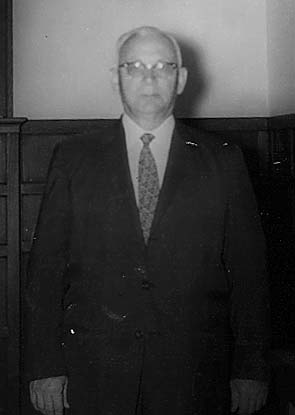
Cecil B. Douthitt (Picture taken by my father, 1950’s, Ft. Smith, Arkansas)

1970

You Have To Start

After being discharged from the Army in 1969 and marrying Paula, we moved to Arkansas (our home state) in 1970. The plan was for me to enroll in college, she would work and I would eventually begin preaching. The preaching part happened earlier than we expected.

One of my mentors lived in Ft. Smith where we located. Cecil Douthitt was one of the preachers of my youth and a close family friend. He was semi-retired from preaching but filled a weekly appointment every Sunday at the Etna church of Christ (near Ozark, Ark.). Back and forth to college classes I would sometimes visit bro. Douthitt.

In the fall of that year it was announced one Wednesday night (at the Southside church in Ft. Smith) that bro. Douthitt had suffered a stroke. The next day I visited him in the hospital. He wasn’t able to say much or react. Sister Douthitt was there at his side. Her fear was that he would never be able to preach again.

She said, “I’ve called the brethren at Etna to tell them they need to call you.” “What?” I said. I think I almost quoted Moses: “I am not eloquent … Please send someone else!” (Exodus 3:10-13).

All she knew was that I wanted to preach someday. “Someday,” not next week! Later than day I received a phone call from Kyle McElroy, who said I had been recommended. Could I be there Sunday morning. I agreed (you’ve got to start somewhere).

On a Big Chief Tablet with a Bic pen, I wrote out about a 15 minute sermon based on John 4:23,24. I wrote every word, making the point I still make today. If you want to know what it means to worship in spirit and in truth, just keep reading from there to the end of the New Testament.

After being stuffed with food at the McElroy’s house, Kyle said, “can you come back tonight?” I said, “no I’m sorry, I don’t have another sermon.” He said, “all right, next Sunday.” That’s how it all started 50 years ago this year.

One word captures it all.

Gratitude.


Christmas

Drew Carey – At White House Press Correspondences Dinner  2002

“Yeah, I read the Bible a lot, you know. It’s just crazy [the way] we celebrate holidays in the United States. I found out just recently there are so many religious holidays we celebrate here in this country that have nothing to do with the Bible at all. Real famous holidays, like Christmas. Christmas has nothing to do with the Bible.

“The birth of Jesus is in the Bible, but not Christmas. The tree is not in the Bible, you know. Gifts-that’s not there either. There’s no place where it says, ‘”Celebrate my birthday,” says Jesus.’ It’s a pagan holiday that the Romans invented that we just do. But everywhere you go, I’m telling you, I’ve seen this so many times, you see a nativity scene and there’s baby Jesus, the manger, sheep, shepherds, Mary, Joseph and Santa Claus right in the middle!”