Isaiah 40:28–31 · Mark 1:35 · Luke 22:43 · Matthew 11:28–29
I didn’t catch his name.
Several weeks back I was in line at Burger King getting my coffee — the large, the same one I get every morning — and the young man behind the counter rang me up. I asked how he was doing. He said good. Said he was working a sixteen-hour shift.
I said, how do you do that?
He said, patience and energy.
And I walked back to my office with those two words and I have not been able to put them down since.
We treat patience like a sedative and energy like a stimulant — as if the goal is to calibrate the dose. Some of us are built to endure. We wait, we don’t spiral, we outlast things. But the drive is low. Others burn through at a rate that leaves patience in the dust. So we manage the deficit and call the arrangement maturity.
That young man didn’t say that. He put them together like they belonged together.
I think he was right.
Isaiah had seen something like this before. Not in a fast food joint, but in exile — in a people wrung out by Babylon, who had been waiting so long they had started to wonder if waiting was all there was. The prophet’s answer did not promise the exile would end on their schedule. It promised something else:
“Have you not known? Have you not heard?The LORD is the everlasting God,the Creator of the ends of the earth.He does not faint or grow weary;his understanding is unsearchable.He gives power to the faint,and to him who has no might he increases strength.Even youths shall faint and be weary,and young men shall fall exhaustedbut they who wait for the Lord shall renew their strength;they shall mount up with wings like eagles;they shall run and not be weary; they shall walk and not faint.” — Isaiah 40:28–31, ESV
The waiting is the mechanism of the energy. Not a prelude to it. The same transaction. And we have been trying to reverse it — most of us — running first and then wondering why there is nothing left for the long walk home.
I keep reflecting on that phrase — the same transaction. Because that’s what we don’t believe. We believe they’re sequential. First you build up the patience, then the energy arrives as the reward. Or first you burn through the energy, and then patience is what you practice while you recover. Either way, one feeds and the other follows. But Isaiah doesn’t describe a sequence. He describes a God who does not faint handing endurance to people who do — and the handing happens in the waiting, not after it. Maybe that’s why we keep running out. We’ve separated what was never meant to come apart.
But the point isn’t the theory. The point is that someone lived it.
Jesus understood this from inside a human frame that could actually be exhausted. Mark records what he did the morning after a day full of synagogue and crowds and healings, the whole town gathered at the door after sundown:
“And rising very early in the morning, while it was still dark,he departed and went out to a desolate place, and there he prayed.” — Mark 1:35, ESV
Before anyone else was moving. Dark. Alone. He was going to where the energy came from.
And in Gethsemane — at the point of maximum cost, the weight of what was coming pressing against the human will of the Son of God in a way no one can easily describe — Luke records what happened:
“And there appeared to him an angel from heaven, strengthening him.”— Luke 22:43, ESV
Not removing the cup. Strengthening him for the carrying of it. He received it the same way he always had — in prayer, in contact with the Father. Don’t expect to see an angel. But the God who strengthened him has already spoken to what he will do for us:
“fear not, for I am with you;be not dismayed, for I am your God;I will strengthen you, I will help you,I will uphold you with my righteous right hand.” — Isaiah 41:10, ESV
Same God. Same promise. Different side of the cross — and a better one.
Patience and energy. In that order.
The question is not whether you have enough of either one. Most of us already know we don’t. The question is whether you know the way back to where they come from — and whether you will go there before the running out, not after.
“Come to me, all who labor and are heavy laden, and I will give you rest.Take my yoke upon you, and learn from me,for I am gentle and lowly in heart,and you will find rest for your souls.”— Matthew 11:28–29, ESV
The rest he is offering is not the absence of the sixteen-hour shift. It is a different source for what the shift requires.
I didn’t catch his name. He had no idea he was describing something ancient, something the prophets named, something the Son of God modeled on his knees in the dark before sunrise.
But here is what he could not tell me — what only the text can say:
Where are you going when both run dry?
Scripture Chain: Isaiah 40:28–31 → Mark 1:35 → Luke 22:43 → Matthew 11:28–29
“Deal bountifully with your servant, that I may live and keep your word. Open my eyes, that I may behold wondrous things out of your law. I am a sojourner on the earth; hide not your commandments from me. My soul is consumed with longing for your rules at all times.”
(Psalm 119:17–20, ESV)
Most of us have never thought of ourselves as foreign. We have addresses, routines, doctors who know our names — all the furniture of belonging.
The psalmist had a different read on that.
I am a sojourner on the earth. Not as metaphor. Not as a devotional way of saying life is hard. As a precise legal category: the resident alien — someone who cannot own the land, cannot settle the way citizens can. The psalmist applies this status to himself, not as poetry. We are not owners here. The land belongs to Someone else.
I have read Psalm 119 for years, and if I am honest, the longing in verse 20 always felt like something I was supposed to imitate rather than something I actually recognized. My soul is consumed with longing for your rules at all times. The word underneath consumed carries the sense of being ground down — a sustained, grinding want. For years I felt a more comfortable version — the rules as customs I observed, not navigation I needed.
What changed — and this is the thing I have been working through — is the sojourner frame in verse 19. When the psalmist says hide not your commandments from me, he is not asking for access to religious instruction. He is asking for what a foreigner desperately needs: the rules that explain how to live in a place you were not born into. The commandments are the map the alien carries. Not a cage. The only orientation the displaced person has.
The depth of the longing is tied to how clearly we feel the displacement. When this world feels like home — when the routines have settled into permanence — the commandments feel like optional enhancement. But we can confess the sojourner identity on Sunday and live as settlers the rest of the week. We accumulate. We invest — and not just financially. We plant ourselves into the rhythms of this present age as though the lease will never expire. The displacement is affirmed as doctrine and forgotten as experience. The commandments drift back into customs. The longing cools. The map gets filed away.
He wrote: “Beloved, I urge you as sojourners and exiles, abstain from the passions of the flesh that wage war against your soul” (1 Peter 2:11, ESV). The abstain is grounded in the identity. You cannot consistently resist what belongs to this world if this world is home.
This thread runs older than Peter. The writer of Hebrews says the patriarchs “died in faith, not having received the things promised, but having seen them and greeted them from afar, and having acknowledged that they were strangers and exiles on the earth” (Hebrews 11:13, ESV). That verse keeps returning to me. They greeted the promises from afar. They did not hold them. And the acknowledgment — it is not their burden to escape. It is the posture that made the faith possible.
We are strangers here. That is the orientation.
The commandments, the rules, the wondrous things the psalmist asks to behold in verse 18 — these are not burdens loaded on us at the border. They are what God gives to a person displaced by design, in a country they were never meant to stay in.
My soul is consumed with longing.
Mine has not always been.
Whether ours is probably depends on how clearly we feel where we are.
“Rejoice in the Lord always; again I will say, rejoice.” — Philippians 4:4
Some of us have made a decision we have never quite admitted to making.
It didn’t happen in a single moment. It gathered, the way sediment gathers — quietly, layer by layer, until one day we looked down and found we were standing on something solid and immovable. We had decided to be unhappy. Not consciously, perhaps. Not with any formal resolution. But the decision was made nonetheless, and we have been keeping faith with it ever since. We maintain what we could release and call it honest feeling.
This is not a comfortable thing to say. We have grown accustomed to thinking of our unhappiness as something that happened to us — the accumulation of disappointments, the weight of difficult circumstances, the long record of what life failed to deliver. And there is no denying that life has been genuinely hard for many of us. Real grief is real. Real loss is real. The Scriptures never pretend otherwise. But there is a difference between grief that passes through us and a disposition toward unhappiness that we have cultivated and defended, sometimes fiercely, for years.
Paul, writing from a Roman prison, said a startling thing: “I have learned, in whatever state I am, to be content” (Philippians 4:11).
The word learned does the heavy lifting in that sentence. Contentment, he says, is not a personality trait some people are born with and others are not. It is something acquired — through discipline, through practice, through the long deliberate work of training the mind. What Paul learned, he had also at some earlier point not yet known. He was not naturally content. He became content, because he decided to.
The inverse follows, and it is worth asking honestly: if contentment must be chosen and cultivated, what does that make discontentment? Unhappiness, when it settles in and stays, is rarely a verdict handed down to us from outside. More often it is a habit of mind we have stopped fighting — a way of reading our circumstances that has become so familiar we mistake it for clear-sightedness.
Israel knew this pattern well. God led them through the wilderness with bread from heaven and water from the rock and a pillar of fire to light their nights. And still they complained — crying in the doorways of their tents that they missed the fish and the cucumbers and the melons of Egypt, the land where they had been slaves (Numbers 11:1, 4–5; 14:2). Their ingratitude was not forced upon them by their circumstances, which were genuinely hard. It rose from within them, from a heart that had learned to tend its grievance and call it memory. That orientation proved devastating. “Nor grumble, as some of them grumbled,” Paul says, applying their example directly to us (1 Corinthians 10:10). The grumbling was not incidental. It was the symptom of a deeper posture of the soul.
I find this particular passage uncomfortable in a personal way. There are seasons I can identify, looking back, where I kept choosing to read my circumstances as evidence against God’s goodness rather than for it. Not dramatically. Not consciously. But the choice was there, made and remade, quietly.
Philippians 4:4 is not a suggestion. “Rejoice in the Lord always” is an imperative — a command of God. We soften it instinctively, as though it were a recommendation for those with favorable temperaments. But God does not command what is impossible. The fact that He commands rejoicing means that rejoicing, even in difficulty, is within reach for those who belong to Him. It means that the failure to rejoice is not merely a personality limitation — it is, in some real sense, a failure of obedience.
That is uncomfortable. But it is also, if we will receive it, a word of freedom. If our unhappiness were simply the product of our circumstances, we would be its prisoners, waiting for the world to change before we could feel differently. But if it is, at least in part, an orientation we have slowly adopted — then it can be revisited. A decision can be unmade. A habit can be unlearned, even if the unlearning is slow.
Paul and Silas, thrown into the innermost cell of a Philippian prison with their feet in stocks, sang hymns at midnight (Acts 16:25). Their circumstances had not improved. But they had not surrendered their joy to their circumstances. There is something in their singing that night that goes beyond temperament or courage. It is the testimony of men who had decided — and who kept deciding — that the Lord was worthy of praise even when everything else had gone wrong.
We are not told the choice is easy. We are told it is possible. And we are told, by the same apostle who sang in chains, that the God of peace will meet us in it: “And the peace of God, which surpasses all understanding, will guard your hearts and your minds in Christ Jesus” (Philippians 4:7). That peace guards those who, by prayer and thanksgiving and the deliberate turning of the mind toward what is true and honorable and good (Philippians 4:8), have stopped defending their unhappiness and started, however haltingly, to fight it.
The question before us is not whether our lives have been difficult. Many of them have been. The question is whether, by God’s grace, we are willing to make a different choice. He is not waiting on our circumstances to improve. He already moved.
At some point we all crave something late night. Dinner had already left my stomach and I wasn’t ready for bed, so I did what most of us do — I picked up my phone and started looking for food. Not cooking. Not getting up and driving somewhere. Just looking. Scrolling through delivery apps and local spots still open, tapping through images of meals I hadn’t planned on wanting five minutes earlier.
And the images were doing their job. The perfect burger — tall, layered, glistening. A steak dinner plated like it belonged in a magazine. Mediterranean bowls with colors so vivid they almost looked fake. Grilled chicken salads that somehow made lettuce look exciting. You know how it goes. You start checking menus, comparing prices, wondering if the condiments come with it or if they charge extra. You read three reviews. You look at the photos one more time. Your mouth is watering and you haven’t even placed the order yet.
So you order. The four-star place with the pictures that sealed it. And when the bag shows up at your door and you open that container — you’re still thinking about those images. The anticipation is still sitting right there in your chest. But what you’re looking at doesn’t resemble anything you had in mind. The lettuce is wilted. The bread is soggy. The whole thing looks like it was assembled by someone who had already clocked out. Unappetizing. Disappointing. And smaller than you expected.
And since you paid for it, you ate it anyway.
And we should be careful here. Wanting a late meal isn’t sinful. Looking for options to find it isn’t sinful. But how often does what we see — what appeals to us, what catches the eye and waters the mouth — actually turn out the way we expected? It doesn’t. Because the world is a deceptive place. People are deceptive. Marketing is deceptive. And the desires of the flesh are completely deceptive. The wanting isn’t the problem. It’s that what the world puts in front of us to satisfy the wanting almost never delivers what it promises.
This is how sin often works
The writer of Hebrews described what Moses understood when he turned away from Egypt: he chose “rather to be mistreated with the people of God than to enjoy the fleeting pleasures of sin” (Hebrews 11:25, ESV). Scripture doesn’t pretend that sin offers nothing. There are pleasures. But they are fleeting — already fading even as they arrive. The advertisement was better than the meal. Moses saw that. Most of us take longer.
James traces the sequence: “Each person is tempted when he is lured and enticed by his own desire. Then desire when it has conceived gives birth to sin, and sin when it is fully grown brings forth death” (James 1:14—15, ESV). Those verbs — lured, enticed — are fishing language. Bait on a hook. Something dangled that appeals to the eye, the appetite, the ambition. It looks like life. Follow it to its end, though, and what James says you find is death.
We see the pattern from the beginning. When Eve looked at the forbidden fruit, she “saw that the tree was good for food, and that it was a delight to the eyes, and that the tree was to be desired to make one wise” (Genesis 3:6, ESV). Appetite, beauty, ambition — the text itself lays out three appeals. John would later name what appear to be these same avenues: “the desires of the flesh and the desires of the eyes and pride of life” (1 John 2:16, ESV). The strategy hasn’t changed. The same lure, the same hook, the same empty plate at the end.
I wish I could say I’ve outgrown the appeal. I haven’t. I know what my particular advertisements look like — the ones that show up when I’m tired, when I feel overlooked, when the day didn’t go the way I needed it to. They’re not dramatic temptations. They’re ordinary ones. And that’s exactly why they work.
The shrewdness of the tempter has never been in offering something obviously dangerous. It’s in concealing the real cost behind something that looks harmless. Paul warned the Corinthians about exactly this: “as the serpent deceived Eve by his cunning, your minds will be led astray from a sincere and pure devotion to Christ” (2 Corinthians 11:3, ESV). Cunning — not force. And Jesus named the source plainly: “He was a murderer from the beginning, and does not stand in the truth, because there is no truth in him. When he lies, he speaks out of his own character, for he is a liar and the father of lies” (John 8:44, ESV). No food advertisement shows you the stomachache. No temptation shows you the aftermath — the guilt, the fractured trust, the slow wearing-down of character: “Do not be deceived: God is not mocked, for whatever one sows, that will he also reap” (Galatians 6:7, ESV). The old proverb knew it too. “Stolen water is sweet, and bread eaten in secret is pleasant.” But the next verse finishes the thought: “he does not know that the dead are there, that her guests are in the depths of Sheol” (Proverbs 9:17–18, ESV)
The advertisement never mentions the cost. It can’t afford to.
So we need — first, honestly — the humility to admit we are susceptible. Not in theory. In practice. “Let anyone who thinks that he stands take heed lest he fall” (1 Corinthians 10:12, ESV). We are not above the advertising. And we need the word of God stored up the way the psalmist described — “I have stored up your word in my heart, that I might not sin against you” (Psalm 119:11, ESV) — because truth is what exposes a false advertisement for what it is. When the Lord Himself was tempted, He did not negotiate. He answered with “It is written” (Matthew 4:4, 7, 10). Scripture. That was His defense, and it has to be ours.
But the deepest comfort may be this: God offers something that actually is what it claims to be. “For the wages of sin is death, but the free gift of God is eternal life in Christ Jesus our Lord” (Romans 6:23, ESV). There is no gap between what God promises and what He delivers. The life He offers in Christ does not arrive lukewarm and smaller than expected. It is — and Paul strains language to say it — more than we could have imagined: what “no eye has seen, nor ear heard, nor the heart of man imagined, what God has prepared for those who love him” (1 Corinthians 2:9, ESV).
Sin advertises well. It always has. But the meal never satisfies. And somewhere, right now, the next advertisement is already catching our eye.
The question is whether we’ve tasted enough of what’s real to recognize what isn’t.
“So teach us to number our days that we may get a heart of wisdom.” (Psalm 90:12, ESV)
A man I know turned fifty-four last year. The moments began to feel heavier—not because he sensed he had more time, but because time itself seemed to behave differently. Each moment felt like the midpoint of an hourglass. We’ve all seen it. Once the sand crosses the middle, everything appears to accelerate. What once felt spacious begins to narrow. What once felt theoretical becomes immediate.
The future stops being an idea and starts becoming a presence.
Questions that once waited politely now interrupt without asking permission.
What’s coming? What remains undone? Where does this actually end?
Endings no longer feel abstract. They feel visceral. Honest. The emptiness of “what’s next” often presses closer, not as panic—but as awareness. Time no longer feels neutral. It starts demanding answers.
You’re not getting any younger now.
That realization doesn’t merely produce anxiety; it produces a demand for interpretation. Moments are no longer interchangeable. They feel charged—weighted with consequence. The issue isn’t getting old. It’s understanding. How should these moments be lived now? What deserves attention? What no longer does?
This is where many people turn instinctively to purpose—but often in the wrong direction.
Scripture never treats time as filler. Days aren’t excess material. They’re measured because they matter. When Moses prays, “So teach us to number our days that we may get a heart of wisdom” (Psalm 90:12), he isn’t asking for more time. He’s asking for clearer sight. Wisdom doesn’t come from extended years. It comes from understanding what time is for.
Ecclesiastes sharpens the tension further: God “has put eternity into man’s heart” (Ecclesiastes 3:11). We carry a sense of permanence inside a life that is not permanent. That tension isn’t a mistake—it’s the point. Time is not the destination.
It’s the classroom.
And this is why the pressure intensifies in the middle.
When the illusion of endless time fades, the soul begins asking different questions. Not louder ones—truer ones. Purpose is no longer about becoming impressive. Identity is no longer about construction. The deeper concern emerges: What will I do with the moment that is my life?
We Look in the Wrong Direction
Most of us search for purpose by watching other people. We trace their paths. We imitate what looks successful or meaningful. We follow lives that seem ordered, confident, full. And when comparison takes root, it doesn’t stay neutral. It becomes coveting—not because we want their possessions, but because we’re ashamed of what we think we’re missing.
James pulls back the curtain on what’s actually happening:
“What causes quarrels and what causes fights among you? Is it not this, that your passions are at war within you? You desire and do not have, so you murder. You covet and cannot obtain, so you fight and quarrel.” (James 4:1–2)
Coveting isn’t mostly about wanting more. It’s about being ashamed of what feels absent.
What’s missing is truth that leads to understanding. We’re not confused because we lack information. We’re confused because we’re trying to discover purpose in a place where it was never meant to be found.
Jesus makes this plain: “Do not lay up for yourselves treasures on earth….. but lay up for yourselves treasures in heaven. For where your treasure is, there your heart will be also” (Matthew 6:19–21).
The heart always follows what it believes will secure life. When purpose is sought horizontally—by comparison, by achievement, by reputation—identity becomes fragile. It has to be constantly defended, updated, validated.
Paul doesn’t describe his life as self-made. He says, “I have been crucified with Christ. It is no longer I who live, but Christ who lives in me” (Galatians 2:20). That’s not radical metaphor. It’s relocation. The center of his life has moved. The self no longer sits on the throne.
And the cross is where this happens—not as decoration, but as the axis of everything.
At Calvary, the vertical and horizontal meet. God reconciles heaven and earth in the body of His Son. Paul writes that through Christ, God was pleased “to reconcile to himself all things… making peace by the blood of his cross” (Colossians 1:20).
The cross doesn’t just forgive sins. It reorders reality. It makes relationship with the ordinary, daily, messy, horizontal world possible by first restoring relationship with God.
Which means purpose isn’t pending. It’s settled.
Life is no longer about inventing meaning before time runs out. It’s about living faithfully inside meaning that has already been declared. Time isn’t something to kill or consume. It’s something to steward. Each moment becomes an opportunity to live in alignment with what’s eternally true.
So the question shifts.
What will I do with this moment?
Will I spend it chasing an identity Christ has already defined? Will I invest it in distractions that promise fulfillment but can’t deliver?
Or will I receive what God has already made clear—that meaning, value, love, and purpose are found not by striving upward, but by abiding in the One who came down?
When everything else feels scattered, God’s truth holds. It gathers up what’s restless in us and puts it where it belongs—in Jesus. Not in what we’ve built or how we compare. Just in Him. The One who existed before time, who entered it, and who remains when it’s gone.
The moment that is your life isn’t wasted when it’s lived in Him.
The same flood that destroyed the world carried the ark. Explore how Scripture reveals salvation through judgment—and why that pattern leads to the cross.
The ark rose plank by plank in full view of everyone. Peter calls him “a herald of righteousness” (2 Peter 2:5, ESV)—and whatever form that heralding took, the ark itself stood as evidence. Something was coming. God had made provision, and the provision implied peril.
No one came.
The ark was finished. Noah and his family entered. And then this: “And the LORD shut him in” (Genesis 7:16, ESV).
God himself closed the door. Not Noah. The Lord sealed the boundary between refuge and ruin, and once it was shut, it stayed shut. The waiting was over. The patience had run its course.
Then the waters rose.
Genesis tells it with unbearable restraint: “The flood continued forty days on the earth. The waters increased and bore up the ark, and it rose high above the earth” (Genesis 7:17, ESV). The same waters. One flood. But inside that single act, two opposite realities unfolded at once. The deluge that drowned the world carried the ark. The storm that ended everything preserved eight people through its very destruction.
We prefer to keep God’s attributes in separate rooms. Mercy here. Justice there. Salvation for the righteous, judgment for the wicked—and a clean wall between them. But the flood will not stay in our categories.
The waters that saved were the waters that punished by death..
Noah was saved through the flood, not from it. He rode the instrument of judgment. For months, the ark floated on the grave of everyone he had ever known. Salvation, for Noah, was not escape. It was survival inside catastrophe, carried by the very thing that destroyed.
When the ark finally rested and the waters receded, Noah stepped out into an emptied world. His first act was not celebration. “Then Noah built an altar to the LORD” (Genesis 8:20, ESV). He worshiped. Something in that passage through the waters had marked him—the weight of being spared while a world perished, the terrible mercy of a closed door.
This pattern does not begin or end with Noah.
The night of Passover, the Lord moved through Egypt. He tells Moses: “When he sees the blood on the lintel and on the two doorposts, the Lord will pass over the door and will not allow the destroyer to enter your houses to strike you” (Exodus 12:23, ESV). The destroyer was active that night—moving, striking. The blood did not cancel the judgment. It marked where judgment would not land. One household lived because another died. The same night. The same visitation. Salvation and judgment, woven into one divine act.
At the Red Sea, the inseparability becomes visible. Israel walks through on dry ground while Pharaoh’s army follows into the same passage. Then the waters return: “The waters returned and covered the chariots and the horsemen; all the host of Pharaoh that had followed them into the sea, not one of them remained” (Exodus 14:28, ESV). The walls of water that formed Israel’s deliverance became Egypt’s tomb. God did not save and then, later, judge. He accomplished both through the same parted sea, the same collapsed walls, the same moment.
This is where the pattern has always been heading: Golgotha.
On a Roman cross, salvation and judgment collapse into absolute unity. There is no sequence here, no before and after. The wrath of God against sin and the rescue of sinners occur in the same act, on the same afternoon, in the same body.
Isaiah saw it centuries before it happened: “It was the will of the Lord to crush him; he has put him to grief” (Isaiah 53:10, ESV). The Father’s judgment falls fully on the Son. Not symbolically. Not representatively in some detached sense. The curse that sin earns lands on Christ. He receives it. He absorbs it. He dies under it.
And in that same crushing, “he bore the sin of many, and makes intercession for the transgressors” (Isaiah 53:12, ESV). This is substitution—not sympathy, but exchange. He stands where we should stand. He is condemned so that we are not. The same cross that displays God’s unyielding opposition to sin displays his relentless love for sinners. You cannot pull these apart without emptying the cross of its meaning.
We want mercy without reckoning. Forgiveness that costs nothing. Rescue with no judgment anywhere in the equation. But God’s character does not rearrange itself for our comfort. His holiness responds to sin—always. Either the sinner bears that response, or the Substitute does. There is no third option.
The cross is the flood. Christ is the ark. And God himself has shut the door.
What does it mean, then, to live as one saved through judgment?
If you are in Christ, you have been carried through the very thing that destroys. The wrath your sin deserved fell somewhere—and it fell on him. You are not merely forgiven; you are survivors of a catastrophe that landed on your Substitute. The flood came. You did not drown. But only because someone else did.
This should shape how we see the world. Noah emerged from the ark into silence—an emptied creation, the old world gone. He did not come out boasting. He built an altar. There is a gravity to being spared, a weight that genuine salvation carries. We live now in the time between the door being opened and the door being shut, and there are people outside the ark.
Do we carry grief for them or triumphalism over them?
There is a quiet fear many believers carry but rarely admit out loud: If God truly transforms my desires, who will I be afterward? Will anything familiar remain?
We imagine that holiness means becoming desireless—flat, emptied of passion, stripped of the longings that make life feel alive. So we hide our desires from God instead of bringing them to Him. Or we try to tame them in isolation, hoping to manage the war quietly.
But Scripture speaks differently. It reveals a God who created desire—not as a liability—but as a doorway to Himself. He never intended desire to be hollowed out. Only redirected.
Think of it this way: desire is a cord that carries current. The power is real regardless of where it connects. Two sockets sit before every human heart—one labeled Worldly, the other Eternal. Same longing. Same voltage. The only question is where you plug in.
Transformation is not God sanding us down into emotionless slabs of obedience. Transformation is God taking what once pulled us toward sin and bending it toward Christ until it becomes something holy. Sometimes you don’t even notice the bending until you look back and realize you no longer want what once dominated your thoughts. Other times, the shift feels slow and uneven—two steps forward, one step back, and then a sudden leap of grace you didn’t expect.
When Desire Tells the Truth About Us
James says something painfully honest about temptation:
“Each person is tempted when he is lured and enticed by his own desire.” — James 1:14 (ESV)
We usually blame temptation on externals: a bad situation, a stressful week, someone else’s influence, something we stumbled across. But James points inward—not for discouragement, but to clarify the battlefield. Temptation attaches itself to something pre-existing and unguarded. We feel that pull because something in us is already leaning. Desire isn’t random. It surfaces where our heart is still unhealed or unanchored.
There’s a moment—so small we often miss it—when desire begins to take shape. Sometimes it comes as a glance. Sometimes as an old memory resurfacing at the wrong time. Sometimes as that vague ache for something more that arrives late at night. We notice it before we decide anything with our will. Desire tells the truth about what still needs Christ. Not the whole truth. But enough.
God Doesn’t Erase Desire—He Gives a New Heart
Many believers fear that if they fully surrender desire to God, He will return them empty. But listen to the language God uses in Ezekiel—a promise He made to Israel about covenant renewal and the coming of His Spirit:
“I will give you a new heart, and a new spirit I will put within you. And I will remove the heart of stone from your flesh and give you a heart of flesh.” — Ezekiel 36:26 (ESV)
The New Testament reveals this promise fulfilled in Christ for all who believe. Paul writes to the Corinthians about the nature of the new covenant, and in doing so, he employs Ezekiel’s imagery:
“You show that you are a letter from Christ… written not with ink but with the Spirit of the living God, not on tablets of stone but on tablets of human hearts.” — 2 Corinthians 3:3 (ESV)
A heart of stone isn’t hard because it’s strong. It’s hard because it refuses to feel rightly. A heart of flesh isn’t weak—it’s alive. God doesn’t ask us to become numb. He asks us to become responsive.
One of the greatest lies is that holiness is the death of desire. But holiness is first God making us His own—set apart by Christ’s blood, belonging to Him. Peter writes that believers are “a chosen race, a royal priesthood, a holy nation, a people for his own possession” (1 Peter 2:9, ESV). Then it becomes the Spirit’s patient work of reorienting our desires toward Christ. Paul commands the Romans: “Do not be conformed to this world, but be transformed by the renewal of your mind” (Romans 12:2, ESV). This renewal is not the subtraction of desire but its conversion.
You may not feel this change immediately. Some desires drop quickly. Others linger long enough that you start to wonder if God forgot about this part of your heart. He hasn’t. He is patient in ways we don’t understand. And He is committed to the long transformation.
When God Converts One Desire Into Another
God doesn’t merely remove sinful desire. He converts it. Transformation in Scripture is an exchange, not an emptying. What follows are examples of this pattern—each grounded in specific texts.
Lust Becomes Love That Protects and Honors
Paul instructs the Thessalonians: “For this is the will of God, your sanctification: that you abstain from sexual immorality; that each one of you know how to control his own body in holiness and honor, not in the passion of lust like the Gentiles who do not know God” (1 Thessalonians 4:3-5, ESV). The passion doesn’t disappear—it is redirected into honor. Love “does not insist on its own way” and “does not rejoice at wrongdoing, but rejoices with the truth” (1 Corinthians 13:5-6, ESV). The same intensity that once consumed now protects.
Greed Becomes Generosity That Rejoices in Giving
Paul provides the clearest example of this inversion:
“Let the thief no longer steal, but rather let him labor, doing honest work with his own hands, so that he may have something to share with anyone in need.” — Ephesians 4:28 (ESV)
Thief becomes giver. Self-centered becomes others-centered. The desire to take becomes the desire to bless. And to the Corinthians, Paul writes: “Each one must give as he has decided in his heart, not reluctantly or under compulsion, for God loves a cheerful giver” (2 Corinthians 9:7, ESV). The cheerfulness reveals that the desire itself has changed.
Anger Becomes Patience That Absorbs and Understands
James instructs: “Know this, my beloved brothers: let every person be quick to hear, slow to speak, slow to anger; for the anger of man does not produce the righteousness of God” (James 1:19-20, ESV). Paul commands the Colossians to put off “anger, wrath, malice” and put on “compassionate hearts, kindness, humility, meekness, and patience” (Colossians 3:8, 12, ESV). The energy that once erupted outward now absorbs, waits, and seeks to understand.
Pride Bends Into Humility That Lifts Others
Paul exhorts the Philippians: “Do nothing from selfish ambition or conceit, but in humility count others more significant than yourselves. Let each of you look not only to his own interests, but also to the interests of others” (Philippians 2:3-4, ESV). James adds the warning and the promise: “God opposes the proud but gives grace to the humble” (James 4:6, ESV). The ambition that once elevated self now elevates others.
Fear of Man Becomes Fear of God
Solomon writes: “The fear of man lays a snare, but whoever trusts in the LORD is safe” (Proverbs 29:25, ESV). The apostles, when commanded to stop preaching Christ, responded: “We must obey God rather than men” (Acts 5:29, ESV). The same capacity to fear—to be moved by what someone thinks of us—becomes the reverent awe that produces courage. The fear doesn’t vanish; its object changes.
Examples from Scripture
Consider Saul of Tarsus—a man whose zeal once drove him to destroy the church. That same fierce desire didn’t disappear when Christ met him on the Damascus road. It was redirected. He became Paul, writing:
“I thank him who has given me strength, Christ Jesus our Lord, because he judged me faithful, appointing me to his service, though formerly I was a blasphemer, persecutor, and insolent opponent.” — 1 Timothy 1:12-13 (ESV)
Persecutor became apostle. Destroyer became builder.
Or consider Peter—the disciple whose fear made him deny Jesus three times in a courtyard. Weeks later, that same man stood before thousands and boldly proclaimed Christ risen (Acts 2:14). Coward became confessor. This is not human willpower. This is resurrection power working in ordinary hearts.
Where Desire Begins to Bend
Sometimes people ask, “How do I know transformation is happening?” Often it’s when the internal conversation starts to shift. You still experience temptation, but now you’re troubled by it instead of entertained. You confess faster because hiding feels heavier. You realize you’re asking God for help sooner than you used to. You notice moments of resistance that weren’t possible before. You find yourself wanting something holy—not out of guilt but out of genuine longing.
These aren’t small things. They’re signs of a heart learning a new rhythm. Paul describes this internal shift beautifully:
“For it is God who works in you, both to will and to work for his good pleasure.” — Philippians 2:13 (ESV)
He changes the will before He changes the work. He adjusts the wanting before the behavior stabilizes. We punish ourselves because the change feels slow. God delights in the slow because it forms depth.
When Old Desires Rise Again
There’s a moment that almost every believer experiences. You thought a specific temptation was behind you—buried, resolved, maybe even healed. Then it rises again out of nowhere. The shame is instant: “Why am I still dealing with this? Have I really changed at all?”
You’re not alone in that experience. The apostle Paul—writing to believers in Rome—describes an internal war:
“For I delight in the law of God, in my inner being, but I see in my members another law waging war against the law of my mind and making me captive to the law of sin that dwells in my members.” — Romans 7:22-23 (ESV)
Paul calls it a war—not a scuffle, not a momentary lapse, but an ongoing campaign. When old desires surface, they do not prove you’ve failed. They prove the fight is still alive. Dead hearts do not wrestle. Yours does.
Direction Matters More Than Perfection
So what do we do when old desires surface? We adjust our direction—not our expectations of instant purity. One of the most freeing truths Scripture offers is this:
“But put on the Lord Jesus Christ, and make no provision for the flesh, to gratify its desires.” — Romans 13:14 (ESV)
Paul does not say “become instantly pure,” “lose all former desire,” or “stop feeling anything tempting.” He says: adjust what you feed. Adjust what you walk toward. That means transformation is less about what you once wanted and more about what you move toward now. Maybe your steps are slow. Maybe they feel uncertain. But direction towards Jesus is discipleship.
A Prayer God Delights to Answer
There is a prayer God delights to answer, though His timing and method may surprise us: “Father, change what I want.”
When prayed sincerely—with humility rather than self-preservation, in faith and submission rather than demand—through the Word, the Spirit begins His quiet, persistent work. The change is not dramatic or overt. It is rarely instant, not always as we expect or understand. But it is always toward Christlikeness.
You’ll notice it in small ways: a softened reaction where once you flared, a new discomfort with compromise you once tolerated, a surprising joy in obedience, a growing love for Christ, a distaste for what once thrilled you. You’ll feel it in moments—sometimes during worship, sometimes during temptation, sometimes during confession.
Desire begins to turn. Slowly. Subtly. But unmistakably. And one day, almost without noticing, you realize: “I’m not who I was.” Not because you lost desire. But because your desire learned a new direction.
Yesterday, I noticed a man outside a Burger King, moving slowly and steadily with a pressure hose, rinsing down the entryway before the doors opened. This morning, he was inside, tending to yet another ordinary task. His hands were busy, but his face told the fuller story—a quiet dissatisfaction, a heaviness that seemed deeper than tiredness. What rose in my mind was the word drudgery—that weight we all feel when life’s routines drain more than they give.
Drudgery is the moment when effort loses meaning. It is the slow unravelling of joy, the place where purpose feels thin and life begins to fold inward. Every human being eventually encounters this state, because in a fallen world, work carries the mark of the curse:
“By the sweat of your face you shall eat bread…” —Genesis 3:19 (ESV)
Yet Scripture doesn’t leave us there. God does not deny the ache of labor; He reframes it. In Christ, the burden of drudgery is not erased, but it is transformed.
Paul captures this transformation in one of the most quietly revolutionary statements in the New Testament:
“Whatever you do, work heartily, as for the Lord and not for men.” —Colossians 3:23 (ESV)
With one sentence, Paul shifts the center of work away from the self and onto the Savior. Meaning is no longer rooted in the task or in the approval of people, but in the God who receives the labor as worship. Work that feels unnoticed by the world becomes fully noticed by heaven.
This is the subtle, powerful shift that lifts drudgery into devotion. A believer’s repeated, ordinary motions—cleaning, teaching, repairing, typing, lifting, driving, cooking—become a pattern of worship offered to God. The task does not need to be glamorous; it needs only to be given to Christ.
Paul reinforces this dignity of simple labor in another passage:
“…aspire to live quietly, and to mind your own affairs, and to work with your hands…” —1 Thessalonians 4:11 (ESV)
Quiet work is not beneath God. God Himself blesses it. He breathes meaning into it. Even Solomon, after wrestling with the apparent futility of toil, reaches this conclusion:
“There is nothing better… than that he should… find enjoyment in his toil. This also… is from the hand of God.” —Ecclesiastes 2:24 (ESV)
Joy does not rise from the task itself—it comes from God’s hand resting upon it.
When a Christian offers even the smallest task to Christ, something unseen but real happens. The monotonous becomes meaningful. The hidden becomes holy. The repetitive becomes a pattern of Christlike formation. Drudgery becomes service. The tedious becomes testimony. The thankless becomes treasured in the eyes of God.
The world may never acknowledge the man outside Burger King. He may never know the impact of his work. But the Father sees.
As the Hebrew writer reminds us:
“God is not unjust so as to overlook your work and the love that you have shown for His name…” —Hebrews 6:10 (ESV)
God does not overlook labor done in love. He does not overlook patterns of faithfulness. He does not overlook the unseen offerings of everyday life. And because He does not overlook them, the believer’s daily rhythms—especially the difficult ones—become places where the Lord strengthens, shapes, and steadies the heart.
Christ does not promise that work will always feel inspiring. But He ensures that work done for Him is never wasted. And this transforms the internal experience of drudgery. The believer begins to realize that the smallest act offered to Christ carries eternal weight.
So if your task today feels beneath you… if your work feels endlessly repetitive… if your enthusiasm feels thin:
Offer it to God. Let drudgery become a pattern of devotion. Let repetition become remembrance. Let the ordinary become the altar.
Because wherever Christ stands with you, drudgery cannot consume you. It becomes worship. It becomes formation. It becomes a pattern through which God quietly reshapes the soul.
There are places in the heart we hold tight—small shadows we defend, old comforts we protect, desires we pretend are harmless. They are not always obvious sins. Sometimes they are nostalgia for a former identity… a way of thinking… an internal pattern that felt like home before Christ called us out of darkness.
Paul calls these “deceitful desires” (Ephesians 4:22, ESV). They are deceitful precisely because they feel like comfort. Sin rarely begins with rebellion.
It begins with desire, James says—“each person is tempted when he is lured and enticed by his own desire” (James 1:14, ESV). Desire influences and speaks: “Just keep this one thing. You don’t have to let everything go.” And we listen, because letting go feels like losing a part of ourselves.
This is why some wounds never heal.
Not because God refuses to heal them, but because we grip them as if they were life itself.
If we are honest, we do not cling to the dark places because they terrify us—we cling because something inside us still desires what lived in the dark. We fear that surrender will leave us empty. We fear that confession will tear open an identity we built long before we belonged to Christ.
Paul sees this conflict clearly. He speaks of the “old self, which belongs to your former manner of life and is corrupt through deceitful desires” (Ephesians 4:22, ESV).
The old self is not a costume you remove—it is a deep pattern of desire you once lived inside. Thus, stepping into the new self is not merely behavior change; it is identity surrender.
This is the identity crisis we rationalize.
We tell ourselves: “I can follow Christ and still keep this part of who I was.” “I will surrender everything except this piece.” “I’ll walk in the light, but this corner of darkness is mine.”
But darkness, even in small doses, cannot coexist with the light of Christ. And grace, though abundant, cannot fill a place we insist on keeping closed. David understood this well. His prayer in Psalm 139 is not rhetorical—it is desperate:
“Search me, O God, and know my heart… see if there be any grievous way in me” (vv.23–24, ESV). He knew he might cling to things he didn’t even recognize. He knew desire could deceive him. He knew his heart needed to be opened, not defended.
Examination is the door. Confession is the hinge. Repentance is the turning. Grace is the flood. But the flood comes only when the door opens.
This is why confession is always paired with identity.
Paul tells us that through the Spirit we cry, “Abba! Father!” (Galatians 4:6–7). Sons release what orphans cling to. Sons trust the Father with what orphans hide. Sons walk in the light because they know the One who stands there loves them.
The real issue is not comfort. It is identity.
We hold onto former desires because they once told us who we were—powerful, desirable, in control, secure, satisfied. But Christ reveals those identities as illusions. To cling to them now is to cling to a life that no longer exists.
The new self cannot be worn over the old self.
It requires the burial of the former life, the release of deceitful desires, and the honesty that admits, “I want this… but I want Christ more.”
Grace stands ready. But grace is a surgeon, not a decorator. It will not dress the wound we clutch as identity. It will heal—but only when the hands open.
So the call today is not dramatic.
It is vulnerable: Be honest about what you still desire. Be brave enough to expose it. Be humble enough to release it. Be confident enough to believe that the Father will meet you there.
Where the heart releases, grace enters. Where the old self dies, the new self rises. Where the wound is opened, the healing begins.
Ponderings
1. What desire from your former life still feels like comfort to you? 2. Where do you sense an internal “identity tug-of-war” between who you were and who God calls you to be? 3. What would it look like today to open your hand and release what you’ve been clinging to?
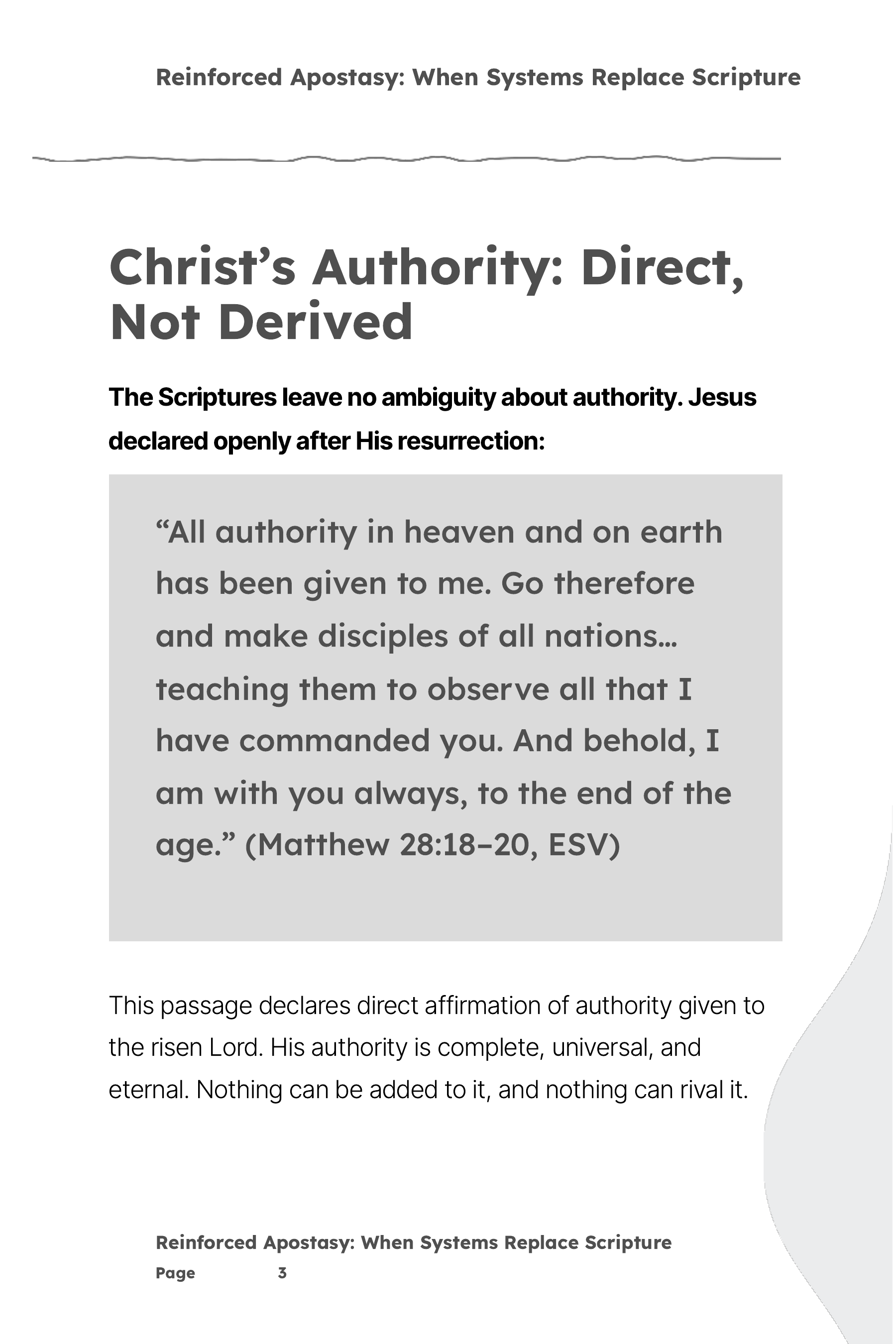
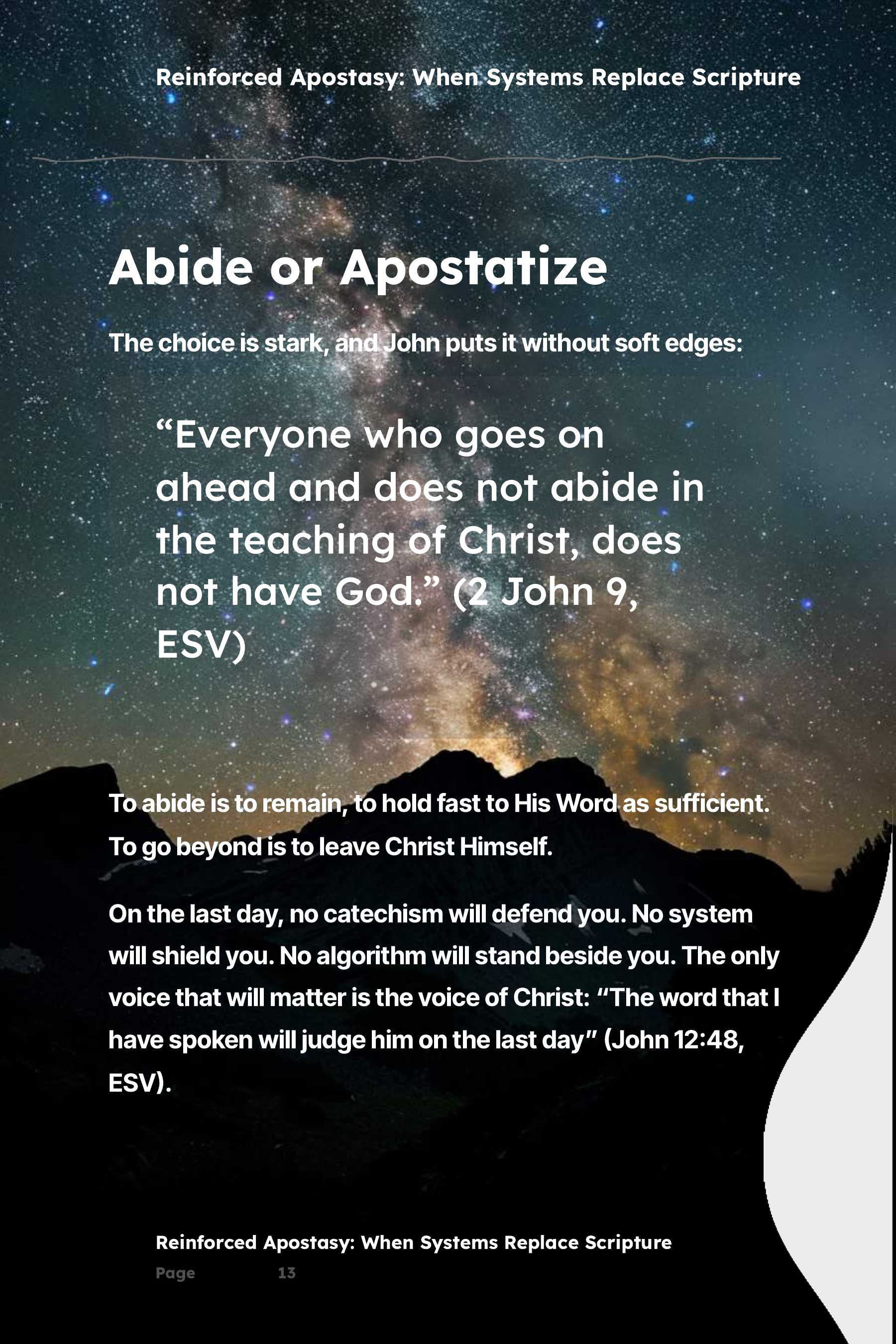
The social media feed is not neutral. It multiplies what men already prefer, echoing catechisms and systems that go beyond the authority of Christ. Repetition begins to feel like revelation, and allegiance shifts quietly. But the Bereans show another way: they examined the Scriptures daily, testing every word by what God had spoken. Apostasy is reinforced daily—so fidelity must be reinforced daily.