
Horizontal Life, Vertical Heart

Some mornings you say the true thing without meaning to. My wife and I were walking out the door—snack bags, the life-size doll, forgetting the juice boxes, diaper logistics—and she said it plainly: everything feels like a struggle right now. Nothing dramatic. Just the ordinary weight of getting a family fed, dressed, and moving, five days a week, for years.

There’s a feeling that goes with that kind of morning, even when nothing has actually gone wrong. Call it wilderness. Not sand and manna. A lengthy pickup line, a grocery budget, a body that’s tired before the day has started.

Paul had a name for it too, and he wasn’t reaching for a metaphor. The warning part of the passage is sharp—”take heed lest he fall”—and we need that caution. But the passage’s strength is what comes next. Writing to a church far removed from Sinai, he pointed back at Israel’s forty years and told the Corinthians plainly what that history was for:

“Now these things happened to them as an example, but they were written down for our instruction, on whom the end of the ages has come. Therefore let anyone who thinks that he stands take heed lest he fall. No temptation has overtaken you that is not common to man. God is faithful, and he will not let you be tempted beyond your ability, but with the temptation he will also provide the way of escape, that you may be able to endure it.” (1 Corinthians 10:11–13, ESV)

Paul doesn’t call the wilderness a punishment. He calls it an example, recorded on purpose so a Corinthian church, and a kitchen table somewhere else entirely, would recognize their own temptation inside someone else’s forty years. The struggle at the door isn’t proof God has stepped back. It’s the territory every believer has always walked, and Paul stitches two promises into one sentence about it: God is faithful, and He provides the way out. Not around it. Through a door that opens while you’re still standing in the pressure.

Here’s where it gets uncomfortable, because the temptation Paul names isn’t just exhaustion. Exhaustion only opens a door. What walks through it is the real question.

I’ll be honest about mine. On the tired mornings, behind schedule, I catch myself looking at people who seem to have it figured out: the recognition, the resolved-looking life, the ease. And something in me asks why I don’t have that. Not out loud. Not admitted, most days, even to myself. But it’s there, and it’s older than this particular morning.

That question has a history longer than mine. Satan asked a version of it to Jesus, on a mountain, after forty days without food—a depletion far more severe than mine at the end of a hard week:

“Again, the devil took him to a very high mountain and showed him all the kingdoms of the world and their glory. And he said to him, ‘All these I will give you, if you will fall down and worship me.'” (Matthew 4:8–9, ESV)

He didn’t invent comparison for the tired and the ordinary. He used it on the Son of God at His most depleted. Which means the version that visits a parent at pickup line, measuring somebody else’s apparent ease against your own struggle, carries an echo of the same offer, sized down to fit an ordinary morning’s errand list. See what they have. Wonder why you don’t. That wondering isn’t the sin yet. It’s the door.

So the question this morning isn’t whether you get tired. Paul already told you that part is common to man. What are you tempted to bow toward, when you are?

Jesus answered the mountain with a refusal, not a negotiation:

“Then Jesus said to him, ‘Be gone, Satan! For it is written, “You shall worship the Lord your God and him only shall you serve.”‘” (Matthew 4:10, ESV)

That’s the way of escape Paul promised—and that’s what it looks like when you take it. Worship rightly placed. Jesus didn’t negotiate with the offer. He turned it down by pointing upward. Scripture says He was “obedient to the point of death, even death on a cross” (Philippians 2:8, ESV). The obedience that started on a mountain with bread and kingdoms held all the way to a cross. Ours is only asked to hold through considerably smaller mountains: a hard morning, a comparison, a wondering that wants to grow into a grievance.

I prayed something true about this before I ever thought to write it down, that I’m horizontally placed in this life: errands, deadlines, a family that needs me, a local congregation that depends on me. Ground level. But that my heart would stay vertical, oriented up instead of sideways at what somebody else seems to have. The struggle at the door doesn’t disappear because the heart turns. The wondering does start to lose its grip, though. One honest look upward at a time.

HEB

Without Excuse, Without Answer

At some level, we could all confess that much of what we think we understand about life has already been bent into a lie. Not just a lie. A sophisticated lie.

Pride becomes self-respect. Greed becomes ambition. Lust becomes authenticity. Cowardice becomes caution. Compromise becomes maturity. Self-rule becomes freedom. Unbelief becomes intellectual honesty.

Notice which one made the list last, and notice why it feels different from the other six. We already suspect we’re lying to ourselves about pride, greed, lust. We caught those on the way down. But the seventh one wears a lab coat. It sounds like a mind still weighing evidence rather than a heart that reached its verdict long ago and has been stalling on the paperwork ever since.

Is unbelief really the one item on this list that isn’t a rename? Or is it just the one we’ve agreed not to check?

The heavens have been running the same argument on repeat since before there was a language to write it down. “Day to day pours out speech, and night to night reveals knowledge. There is no speech, nor are there words, whose voice is not heard. Their voice goes out through all the earth, and their words to the end of the world” (Psalm 19:2-4, ESV). That’s not evidence waiting to be discovered. What is left to argue when the witness never stops testifying?

And the Psalms don’t treat the denial of it as an intellectual position in the first place. “The fool says in his heart, ‘There is no God'” (Psalm 14:1, ESV). The verb matters. He doesn’t conclude it or reason his way there. He says it, from the heart, because this was never primarily a matter of the head.

Paul makes the same case, and he makes it as an indictment, not an offer:

“For the wrath of God is revealed from heaven against all ungodliness and unrighteousness of men, who by their unrighteousness suppress the truth. For what can be known about God is plain to them, because God has shown it to them. For his invisible attributes, namely, his eternal power and divine nature, have been clearly perceived, ever since the creation of the world, in the things that have been made. So they are without excuse. For although they knew God, they did not honor him as God or give thanks to him, but they became futile in their thinking, and their foolish hearts were darkened” (Romans 1:18-21, ESV).

Read that again and notice what it doesn’t say. It doesn’t say the evidence was ambiguous. It doesn’t say a better argument might have tipped the scale. It says the testimony was plain, clearly perceived, and that the response to plain testimony wasn’t doubt. It was suppression. Suppression is not merely something that happens to the mind. It’s something the will enlists the mind to do, on purpose, because the alternative costs too much.

“Without excuse” is a courtroom word before it’s anything else. It describes a defendant who has already read the file. Picture him asking the court for one more continuance to review evidence he was handed months ago, evidence he’s already quoted back to the prosecution correctly, evidence he privately admits is airtight. It means more than that he lacks a convincing explanation. It means the explanations have run out. The evidence has already answered him, and now he has no answer for it. He isn’t confused. He’s just stalling. What do we call a defendant who keeps requesting more time to study a file he’s already memorized?

That’s what verse 21 catches in the act. Not, they did not know him. They knew him. The problem was never a missing fact. It was honor. It was thanks. It was the debt already owed on evidence already delivered, and it got renamed instead of paid.

I’ll own the version of this closest to home before saying another word about anyone else’s. I’ve lived inside the inversion, at a time in my life when I was not on the right side of the Gospel. I’ve hidden pride under the name of self-respect. I’ve called greed ambition, and lust authenticity, the way the world defines it. I lived the cowardly life, accepted just about anything, and called it maturity. I called self-rule freedom, and reveled in it. I called the whole arrangement honesty. It was all a lie. It was the same suppression we are exposing now, together.

As a Christian who now walks by faith, I can only feel the way Paul did. I count it all rubbish (echoing Philippians 3:8).

Real intellectual honesty was never going to stay quarantined at “there might be a Creator.” It has a name to reckon with, and that name gives the same diagnosis Paul already gave. Now let’s read what John wrote.

“And this is the judgment: the light has come into the world, and people loved the darkness rather than the light because their works were evil. For everyone who does wicked things hates the light and does not come to the light, lest his works should be exposed” (John 3:19-20, ESV).

That’s the same file Paul opened, signed by a second witness. The light that had been shining through creation the whole time finally had a face, and the response to it was the one Romans 1 already diagnosed. Not because the light was dim. Because it was, if anything, too bright for what people were protecting.

But the same chapter that names the judgment also names the exit from it: “whoever believes in him should not perish but have eternal life” (John 3:16, ESV). Real honesty was never going to stop at “there’s probably a Creator” and call the inquiry finished, because the light it was avoiding turned out to be a person who could actually be believed, not just a fact to be conceded.

Unbelief renamed can hold the door shut for a while. It cannot hold it shut forever. The light has come into the world anyway.

Pride becomes self-respect. Greed becomes ambition. Lust becomes authenticity. Cowardice becomes caution. Compromise becomes maturity. Self-rule becomes freedom. Unbelief becomes intellectual honesty.

We are masters of futility. We rename the darkness, defend the new name, and call our refusal honesty. Still, the light has come.


Scripture chain: Romans 1:18-21 (ESV) · Psalm 19:2-4 (ESV) · Psalm 14:1 (ESV) · John 3:16, 19-20 (ESV)

HEB

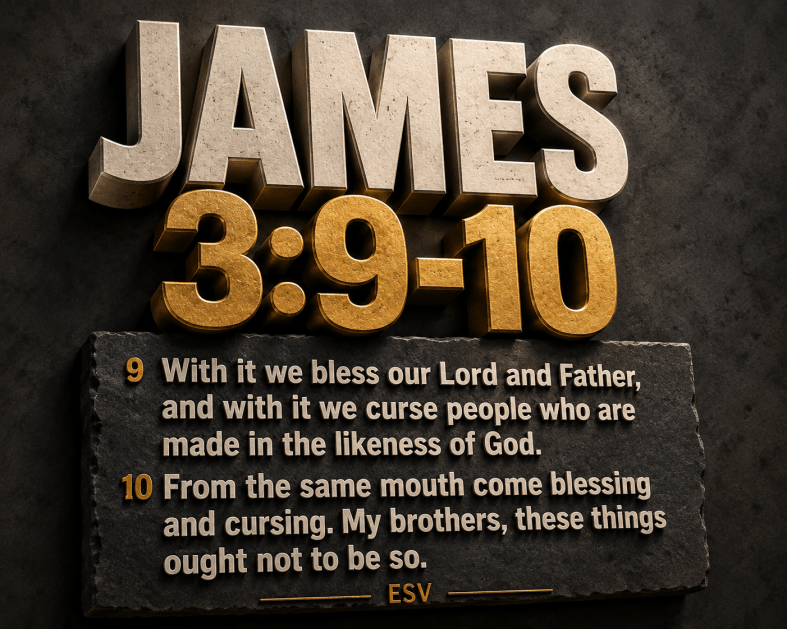
The Likeness: James 3:9-10

There is a strange double vision in the way Scripture talks about us. In the same Book, often in the same breath, we are told that we are ruined and told that we are royal — and we are not permitted to pick one and drop the other. James presses both into a single sentence — and he hangs it on the tongue, that small, restless member behind the most ordinary thing in the world, the things we say:

“With it we bless our Lord and Father, and with it we curse people who are made in the likeness of God.” (James 3:9)

That word it has a history in the verses just before. James has spent the whole paragraph on the tongue: a small member, he says, that boasts of great things, a spark that sets a forest ablaze; a fire, a world of unrighteousness, set among our members and staining the whole body; a thing no human being can tame, a restless evil, full of deadly poison. And then he springs the trap the portrait was built for. This same untamable tongue blesses God and curses people — from the same mouth come blessing and cursing — and his verdict is blunt: these things ought not to be so.

“From the same mouth come blessing and cursing. My brothers, these things ought not to be so.” (James 3:10)

And what he assumes is everything. The people we curse — the neighbor who wronged us, the stranger who cut us off, the figure on the screen we have decided to despise — are, at the moment we are cursing them, still “made in the likeness of God.” James is writing long after Eden, to and about sinners, and he reaches without hesitation for the language of the first page. The fall bent the image. It did not burn it off. The stamp is defaced; it is not erased.

The Bible insists on this from very early, and rests real weight on it. When Genesis opens, it does not command the image into being or argue for it; it reports it as a finished fact about what man is: “in the image of God he created him; male and female he created them.” And then, after the flood, after the human race has thoroughly proven how marred that image has become, God grounds the gravest of prohibitions on it still standing: “Whoever sheds the blood of man, by man shall his blood be shed, for God made man in his own image.” If the image had washed out with the fall, that command would have lost its ground. The likeness survives the ruin — which is exactly why a careless word flung at a person is never a small thing. It is aimed at someone who bears, even now, even unwashed, the mark of his Maker.

But the bent image is not the end of the account, and it was never the highest thing in it. Paul speaks of the image not as a relic to be carefully preserved under glass but as something alive and in motion — being remade:

“and have put on the new self, which is being renewed in knowledge after the image of its creator.” (Colossians 3:10)

Being renewed. Which means it was marred, or there would be nothing to renew. And renewed “after the image of its creator” — measured against a pattern. Paul tells us in the same letter whose face that pattern wears:

“He is the image of the invisible God, the firstborn of all creation.” (Colossians 1:15)

There is the whole arc in two words across two pages. Man was made in the image. Christ is the image. The likeness stamped on Adam in the garden was never an end in itself; it was pointing forward the entire time, a true thing that pointed past itself to a truer — to the one Man in whom the image is not bent or faded but entire. What was given in the garden and lost in the rupture is not merely patched in the gospel. It is fulfilled in a Person who was the image all along, and our remaking is not the recovery of a lost antique but conformity to him.

We are not told, and should not pretend to settle, exactly what the image consists of — whether reason, or the capacity to love, or the charge to rule, or some union of them all. Scripture asserts the image and defends it and renews it without ever laying it on the table to be taken apart. What we are given is enough: you bear it, your fall did not abolish it, and Christ is its true and unbroken measure.

So hold both halves the way James held them, and let them do their work on you. The next time you are tempted to despise someone — to write a person off, to curse with the same mouth you bless God with — remember what your contempt is aimed at: a likeness that would not wash out, however buried under the wreckage. And the next time you are tempted to despair of yourself, to conclude you are too far gone to be worth God’s trouble, remember the same thing turned toward you: the image you cannot seem to scrub clean is the very thing he is patiently remaking, after the face of his Son. You were made in a likeness no sin could fully erase. You are being remade into the likeness of the One who is that image entire. Treat every face you meet — including the one in the mirror — as what it actually is.

HEB

Nothing Climbs On Its Own

I had been moving in the same water for a some time, and somewhere along the way I started calling it a walk.

The strokes looked like progress. You get tired the way you would get tired on a real journey, so the fatigue feels earned. But the shoreline never changes. And if you are honest about it, you know the difference between swimming toward something and treading water to keep your head up.

For a while I thought the dullness was a gap in what I knew. I needed a better study, a newer book, one more framework laid over the last one. So I went looking for richer food. And the richer food tasted like cardboard.

Hebrews has a name for what was actually wrong with me, and it is not flattering. “For though by this time you ought to be teachers, you need someone to teach you again the basic principles of the oracles of God. You need milk, not solid food, for everyone who lives on milk is unskilled in the word of righteousness, since he is a child. But solid food is for the mature, for those who have their powers of discernment trained by constant practice to distinguish good from evil” (Hebrews 5:12–14, ESV).

Read that again slowly. The problem was never the food. The food was solid. The problem was the palate.

A palate is built by what it eats. Feed it sugar long enough and a ripe tomato can taste like nothing at all. The very instrument you use to judge the meal has been shaped by every meal that came before it. So when the dense, demanding word of God arrives and a person sets it down and says it tastes like cardboard, the honest reading is not that the bread went stale. It is that the mouth was raised on something thinner. And underneath all of it ran an invitation I had stopped hearing years ago, the one about tasting and seeing.

Here is the part that finally loosened something in me. There is a law written into the matter of the world, and it runs in only one direction. Leave a garden alone and you do not come back to find it more orderly. Leave the garage, the body, the old friendship alone, and the same thing happens. Things come apart on their own. Things never come together on their own. Heat spreads out and never gathers; the iron rusts; the sandcastle slumps back into sand; the room you cleaned a week ago is somehow a mess again and nobody can say exactly when. Physicists have a cold phrase for it. The rest of us just call it the way of things.

The Father set that law into creation long before anyone had the equations for it. And what is true of the garden is just as true of the soul. A palate does not drift upward toward solid food. Left to itself, it reverts. It goes back to milk. The dullness I kept treating as some private failure was, in part, the world running its one direction through me, the way it runs through anything left untended.

I am making that sound like a lecture. Let me say it plainer. Nobody grows up by accident.

Which makes the rebuke in Hebrews harder, not softer. “By this time you ought to be teachers.” Time had passed. The years had stacked up. And the years, by themselves, had taught the palate nothing, because a calendar cannot train a mouth; only the daily, unglamorous practice can. A person can sit under good teaching for decades and still arrive carrying a child’s discernment, because the years had quietly been mistaken for the work.

If that were the whole letter, it would crush you. It is not. The same writer who calls them children turns a few lines later and says, “Though we speak in this way, yet in your case, beloved, we feel sure of better things—things that belong to salvation” (Hebrews 6:9, ESV). The honesty about how far behind they are never curdles into a sentence against them. He believes better of these people than his own rebuke would suggest, and he stops to tell them so.

And then there is the question the whole thing turns on. What is the solid food? What is the dense thing the trained palate is finally able to taste? It is not even a more complicated doctrine. It is a power. Paul prays that his readers would come to know “what is the immeasurable greatness of his power toward us who believe, according to the working of his great might that he worked in Christ when he raised him from the dead” (Ephesians 1:19–20, ESV).

That claim is larger than it looks. Everything in this world runs down; the direction is always toward the grave. And then one morning the direction reversed. One tomb where the decay ran backward. And that reversal was not powered from inside the system; nothing in here had the strength for it. It came from outside. Paul says the very power that raised Jesus up out of death, against the whole grain of the world, is turned toward the person you actually are, not the better one you keep waiting to become. “Toward us who believe.”

That invitation had been open the whole time, long before Hebrews put words to the problem. “Oh, taste and see that the Lord is good! Blessed is the man who takes refuge in him!” (Psalm 34:8, ESV). The command assumes a mouth, and a mouth is a thing that can be taught.

So I am learning to stop waiting until I feel mature before I act like it. That feeling arrives last, if it arrives at all. Before it, there is only the bite. You take the dense thing while it still tastes like cardboard, and you take it again the next day, and the body that has been fed thin food for years begins, slowly, to remember what it was made for. The change is not yours to manufacture. The strength to digest what you are swallowing was never your own. It is the risen Christ’s, lent to you every day, the same strength that carried Him up out of the grave.

I am still in the water some mornings. But I have stopped calling it a walk. And I have been reaching for the food I cannot yet taste, the same food set in front of all of us, on the word of the One who promised the palate can be retrained.


Texts: Psalm 34:8; Hebrews 5:12–14; Hebrews 6:9; Ephesians 1:19–20 (ESV).

The Name We Cannot Build

The Name We Cannot Build

I invited someone to services a few weeks back. They came. I honestly was not expecting it. They sat through everything: the singing, the teaching, the breaking of bread. They bowed their head during the prayer. They did not sing the songs. Polite about all of it. Seemingly engaged. After services ended they left. Promptly. They have not come back. I have not asked them why yet. Time, on their part, to process is more important than a hasty set of questions. Lord willing that time may come and maybe some of what is being written now will change in some material way. We’ve seen this time and time again. Someone comes to worship. They participate in some obvious way. We ask them the we questions. The ones where we would like to get to know them better. Sometimes there are connections. Sometimes people just never return.

When this occurs we go through this process of thinking what I think most of us do. I ran the inventory. Was it the singing, the plain slightly flat voices with no band behind them? Was it the three and one half part harmony a cappella? Was it the teaching, which stayed direct, avoided modern therapy language, and close to the text? Was it that we had nothing to hand them on the way in, no worship program, no spectacle of lights, nothing built to impress a person used to being entertained by everything else? I kept going down the list.

Here is what I skipped, at least at first. I didn’t ask whether the standard they were measuring us by was the right standard to begin with. We often have no awareness of where they come from spiritually. We can see interest, partially, but only what’s externally obvious. Those things are never good indicators of what’s really going on inside the person. And when they leave, with little to comment about, the not-knowing is what we are left with.

People just leaving, without commentary, is an old grief. John knew it. He wrote to a fellowship that had watched some of its own walk away:

“They went out from us, but they were not of us; for if they had been of us, they would have continued with us. But they went out, that it might become plain that they all are not of us.” (1 John 2:19, ESV)

I have to be careful with what I’m saying here. John is describing people who had been counted among the believers and then abandoned the faith, and he says their leaving showed where their anchor had been the whole time. He is not naming a guest who slipped out a side door. The grief can feel identical. The care for the soul walking away also identical.

We should never give up on those who came in the moment, whatever brought them in. Even when the position of the heart becomes clear and we hear with our own ears, “This was not what I wanted or expected,” we keep the door open. I’ve seen people who give chase to this outcome by asking what could we have done to change their heart? Jesus did not chase the crowd that turned back. He asked the twelve, and let the others go. There is another chase still that can lead to doctrinal drift. We might try and accommodate to win the soul, but the outcome is often not a soul won if we must compromise what is commanded to reach that soul.

A crowd once heard the hardest words Jesus ever spoke. The response stings like this:

“After this many of his disciples turned back and no longer walked with him.” (John 6:66, ESV)

No longer walked with Him. These were not strangers. They had followed Him. They had eaten the bread He multiplied with His own hands. And when His word turned out to be harder than the experience they had come for, they turned around and went home. Jesus let them go. Then He asked the twelve whether they meant to leave too, and I have never gotten over Peter’s answer: “Lord, to whom shall we go? You have the words of eternal life.” (John 6:68, ESV)

That is the part that should frighten us. The visitor with a different taste in how the New Testament defines worship music is of the same mind of people who stand in front of Christ Himself, hear His word, and walk the other way.

Let me take us somewhere older still. Before there was a church, before there was an Israel, a people gathered on a plain and said to one another,

“Come, let us build ourselves a city and a tower with its top in the heavens, and let us make a name for ourselves, lest we be dispersed over the face of the whole earth.” (Genesis 11:4, ESV)

Read that again. We learned the Babel story early. We colored the page of the tower. The people scattered. They wanted a name, and they meant to build it themselves. For their own glory. With their own bricks. To their own height. I am not pointing at anyone’s worship and calling it Babel. Wanting to be moved when we gather is a human thing, and a full room can be a good one when aligned with God’s authority. What is as old as that plain is the motivation underneath the building. It is the moment we start measuring the church by the name it can raise instead of the Lord it abides in. This impulse is, in our case, a human interest mostly.

The place I keep reaching to understand is that abiding means the shape Paul draws of Christ Himself. He was the one “who, though he was in the form of God, did not count equality with God a thing to be grasped, but emptied himself, by taking the form of a servant, being born in the likeness of men.”(Philippians 2:6–7, ESV)

He veiled the open display of His splendor and went down.

“And being found in human form, he humbled himself by becoming obedient to the point of death, even death on a cross.” (Philippians 2:8, ESV)

All the way down. And only on the far side of all that descent, this: “Therefore God has highly exalted him and bestowed on him the name that is above every name.” (Philippians 2:9, ESV)

Notice the difference between the Shinar plain and the cross. At Babel the name was seized. At the cross the name was given. The glory had been His from the beginning. He prayed for it on His last night:

“And now, Father, glorify me in your own presence with the glory that I had with you before the world existed.” (John 17:5, ESV)

He still waited on the Father to hand it back.

This is what the visitor never knew to come asking for. I keep having to learn it over again, too. Christ gave up his glory and was given it back; we keep trying to manufacture our own glory and calling it worship. We ponder what draws a crowd, decide the crowd has found the weight that matters, and start raising a name for the church the way the people on that plain raised their tower. God did not ask us to build His glory for Him. He asked us to abide in the One who already carries it.

Which takes us where John takes his own readers, in the same letter where he had watched people go: “And now, little children, abide in him, so that when he appears we may have confidence and not shrink from him in shame at his coming.” (1 John 2:28, ESV)

Confidence or shame, at the end of that one sentence. He writes that to church people, not outsiders.

So here is the question the preacher part of me will not let us walk past. On the day He appears, the question will be heavier than the room we filled: did we abide in Him? If we have spent our years raising a name of our own, our own draw, our own version of what the visitor came hoping to feel, we will stand there with a lot to show and nothing underneath it. Shrinking back from the very One we built it for.

I think about that seat of the invited visitor. I never learned what happened. The room thins out. It aches when it does. People come once, or twice, and do not come back. Some of that we cannot help. I have stopped running the inventory the way I used to. The inventory was the wrong question. The question is whether what we have is Him. It should always be this question. We have Jesus Christ to offer, nothing more, nothing less.

The mark He looks for at that appearing is the one John names in the next breath: “If you know that he is righteous, you may be sure that everyone who practices righteousness has been born of him.” (1 John 2:29, ESV)

A family likeness. The Father’s righteousness showing up in people who did not chase their own glory and stayed.

Scripture chain: 1 John 2:19; John 6:66; John 6:68; Genesis 11:4; Philippians 2:6–7; Philippians 2:8; Philippians 2:9; John 17:5; 1 John 2:28; 1 John 2:29 (all ESV)

Where Paul Wrote From

Romans 6:3–4

When I started walking with Christ, I thought growth would feel like climbing a mountain. Step by step, up. Mostly it has felt like walking around the same mountain a different way.

If you’ve ever hiked a steep trail, you know how this works. The trail can’t go straight up. Too steep. So it switches back and forth. You walk sideways for ten minutes one direction. You hit a bend and walk sideways the other way. The summit is somewhere up there, but you almost never feel like you’re going toward it. You’re just going sideways. The boot prints in the dirt tell you everyone before you walked it the same way.

Paul wrote his letters from inside that kind of walking.

“Do you not know that all of us who have been baptized into Christ Jesus were baptized into his death? We were buried therefore with him by baptism into death, in order that, just as Christ was raised from the dead by the glory of the Father, we too might walk in newness of life.”

Romans 6:3–4, ESV

Notice the verb. It’s walk. Not arrive. Not sprint. Walk. Step by step, day by day, sometimes forward and sometimes sideways. The “in order that” tells you why you’re walking. The walking itself is what it looks like to be a baptized believer over time.

Solomon had said something similar centuries before Paul ever wrote a letter.

“Consider the work of God: who can make straight what he has made crooked? In the day of prosperity be joyful, and in the day of adversity consider: God has made the one as well as the other, so that man may not find out anything that will be after him.”

Ecclesiastes 7:13–14, ESV

Some paths are crooked because God put a bend in them. You don’t get to straighten them out. The new life you’re walking in happens on the path that’s actually under your feet. Not on some other path you wish you had.

There’s a loneliness that comes in the middle of all this. The old self has been pulled apart enough that you don’t recognize yourself in the old patterns anymore. The new self hasn’t come together enough that you recognize yourself there either. You’re somewhere in between, what I’d call the comma between buried-with-Christ on one side and walking-in-newness on the other. You know where you’re going. You can quote the verse that says it. But day after day it doesn’t feel like you’re going anywhere. The verses were supposed to make this clearer.

Then you read Paul.

“For I do not understand my own actions. For I do not do what I want, but I do the very thing I hate. Now if I do what I do not want, I agree with the law, that it is good. So now it is no longer I who do it, but sin that dwells within me. For I know that nothing good dwells in me, that is, in my flesh. For I have the desire to do what is right, but not the ability to carry it out. For I do not do the good I want, but the evil I do not want is what I keep on doing. Now if I do what I do not want, it is no longer I who do it, but sin that dwells within me.”

Romans 7:15–20, ESV

Paul wrote that. The apostle. Inspired by the Spirit. And what he confessed there is what most of us have felt at one time or another. Wanting to do right. Doing the opposite. Not understanding ourselves. The Holy Spirit didn’t edit that out of Paul’s letter to make him look like he had it all together. The Spirit let him say it. That confession is in the Bible because God put it there.

The book we’re trying to walk by was written, in part, by a man who didn’t always know which direction his next step was going.

So here’s the question. When the walking feels like it isn’t going anywhere, what are you actually walking toward?

I can’t always tell, honestly. Some days the slow climb up a switchback feels exactly the same as treading water and calling it walking with God. The next step on the trail feels just like the next step on level ground until you get to a bend and look back and see you’ve actually climbed. The difference isn’t in how the step feels. The difference is whether the path you’re on is going somewhere.

Romans 6:4 says the path does go somewhere. The verb in the verse is walk. Walking just keeps going, even on days when the going feels sideways. And the verse names where the walking ends up. Newness of life.

Paul says something like this again in a different letter, this one to the Christians at Galatia.

“But I say, walk by the Spirit, and you will not gratify the desires of the flesh. For the desires of the flesh are against the Spirit, and the desires of the Spirit are against the flesh, for these are opposed to each other, to keep you from doing the things you want to do.”

Galatians 5:16–17, ESV

To keep you from doing the things you want to do.

That’s the sideways feeling again, named by the same hand that wrote Romans 7. It’s in the verses themselves. You’re not failing when you feel that way. You’re walking where Paul was walking when he wrote the words.

So keep walking. Take the same step you took yesterday. The summit is up there. The path goes there. The Bible says so.

Walk in newness of life. Just keep walking.

HEB

When Faith Outgrows Its Container

You take your usual seat one morning and look across the auditorium. Three rows up sits a brother whose faith you have watched for a year. A year ago he was unsteady. Quiet in class, hesitant in prayer, carrying a weight you could see from across the room. This morning he is leading the singing. His voice is not better. The weight has not left. But something has shifted, and you cannot quite name when.

Then comes the question that decides what kind of believer you are about to be.

Where does the credit go?

The instinct is to congratulate him. To find him after services and tell him how much he has grown. There is nothing wrong with the words. But notice what the instinct assumes. It assumes that growth is a thing he produced, an achievement to be honored, a project he can finally check off. The instinct treats him as the agent and you as the admiring witness.

Paul will not let us stay there.

“We ought always to give thanks to God for you, brothers, as is right, because your faith is growing abundantly, and the love of every one of you for one another is increasing.”

(2 Thessalonians 1:3, ESV)

Read it carefully. Paul does not write to congratulate the Thessalonians. He writes to give thanks to God for them. The faith is growing, present continuous, an ongoing work. The love is increasing. And the response Paul models is worship, not applause. We ought always to give thanks to God for you, as is right. The rightness is structural. The credit belongs to the one whose work is producing the fruit, and the fruit appears in a brother three rows up.

This is the small revolution thanksgiving performs. It re-locates the agent.

Being thankful means we understand something is being given. The gratitude is not a feeling we manufacture. It’s the recognition that comes when we’re seeing rightly. And when the seeing is right, attention turns away from what we think we lack toward what God is multiplying. Not in our own life only. In the auditorium. In the brother three rows up. In the family across town that prayed differently this year than last.

The work of thankfulness, then, has more to do with where we look than with what we feel.

Mark tells of a man who could not walk. Four friends carried him on his bed, dug through a roof, and lowered him into the room where Jesus was teaching.

“And when Jesus saw their faith, he said to the paralytic, ‘Son, your sins are forgiven.’ . . . ‘I say to you, rise, pick up your bed, and go home.’ And he rose and immediately picked up his bed and went out before them all, so that they were all amazed and glorified God.”

(Mark 2:5, 11–12, ESV)

This is what spiritual growth often looks like. A man who could not walk, walking. Not because he became strong, but because the One who heals spoke. The bed he carries out is the bed that carried him in. The evidence of his weakness becomes the evidence of God’s work.

When you watch a brother grow, you are watching a version of that scene. He was lame in some place, fearful or distracted or distant, and he is walking now. The walking is not his accomplishment. It is the testimony of who got to him.

So why is the temptation to congratulate so strong?

Because gratitude that bends outward costs us something. It requires the relinquishment of a quiet pride that wants to think it had a hand in the rising. It requires us to admit that God’s manuscript is taking the story away from us and giving it to someone else, and that this is good. That the displacement is not loss. That seeing the growth in another believer and thanking God for it, by name, in prayer, is itself the evidence that God is doing the same work in us.

This is the part that is harder to say plainly. Thankfulness is harder when you are focused on yourself. The inward gaze cannot bend the gratitude outward. The man who is busy curating his own development cannot rejoice cleanly when the development shows up next to him.

I know this because I have caught myself doing it. The brother three rows up grew, and the first thing in me was not gratitude. It was an inventory of where I was. That inventory is what I’m trying to learn to set down.

But when the focus shifts, when we begin to receive our own growth as something God has produced rather than something we have managed, the auditorium can begin to change shape. The brother three rows up is no longer competition; he becomes evidence. The sister whose marriage held when it should have broken is no longer a mystery; she becomes testimony to the One whose mercy held it. We ought always to give thanks to God for them, as is right.

There is a season in the Christian life when this becomes the dominant note.

Earlier, the prayers are mostly about ourselves, our struggles, our fears, our stalled places. Then God begins doing the slow work of bending the gaze outward. The prayers shift. Names of others appear in them. They are no longer items being checked off; they are places where God is moving, and we have been allowed to watch. The thanksgiving thickens. Sometimes it brings tears.

“Jesus wept.”

(John 11:35, ESV)

The reasons were His own. Lazarus, Jerusalem, the weight of what He came to bear. But there is something instructive in that two-word verse for the believer who finds himself weeping in prayer over the growth in others. The grief and the gratitude are not opposites. Sometimes they arrive in the same breath. Thankfulness in weakness, where God’s strength abounds and grace trains obedient longsuffering, that prayer rarely stays composed.

Paul did not congratulate the Thessalonians. He gave thanks to God for them, from a Roman city, under his own pressure, watching a church grow under theirs. The thanksgiving was not the conclusion of his pastoral work but the form his pastoral work took.

Consider what your assembly looks like the next time you walk in.

Name the brother whose faith has grown over the past year. Name the sister whose love for the family has thickened in spite of what tried to shrink it. Name the young couple who started showing up differently. Name the older saint whose prayers have changed register.

Then thank God for them. By name. This week. More than once. They are living places where God has let you watch Him work; treat them that way in prayer.

And tell at least one of them what you have noticed. This is witness, not flattery — say it that way. I have watched God do something in you this year, and I have given thanks for it. The naming is part of the work. It returns the credit to its rightful place. It tells the other person what you have seen and what you have not been the source of.

Faith that grows under pressure is the work of God. The right response of those who watch it grow is thanksgiving. And the thanksgiving, when it bends outward, is the evidence that we are becoming like the One whose work it is.

Scripture chain: 2 Thessalonians 1:3 · Mark 2:1–12 · John 11:35

HEB

Patience and Energy

Isaiah 40:28–31 · Mark 1:35 · Luke 22:43 · Matthew 11:28–29

I didn’t catch his name.

Several weeks back I was in line at Burger King getting my coffee — the large, the same one I get every morning — and the young man behind the counter rang me up. I asked how he was doing. He said good. Said he was working a sixteen-hour shift.

I said, how do you do that?

He said, patience and energy.

And I walked back to my office with those two words and I have not been able to put them down since.

We treat patience like a sedative and energy like a stimulant — as if the goal is to calibrate the dose. Some of us are built to endure. We wait, we don’t spiral, we outlast things. But the drive is low. Others burn through at a rate that leaves patience in the dust. So we manage the deficit and call the arrangement maturity.

That young man didn’t say that. He put them together like they belonged together.

I think he was right.

Isaiah had seen something like this before. Not in a fast food joint, but in exile — in a people wrung out by Babylon, who had been waiting so long they had started to wonder if waiting was all there was. The prophet’s answer did not promise the exile would end on their schedule. It promised something else:

“Have you not known? Have you not heard? The LORD is the everlasting God, the Creator of the ends of the earth. He does not faint or grow weary; his understanding is unsearchable. He gives power to the faint, and to him who has no might he increases strength. Even youths shall faint and be weary, and young men shall fall exhausted but they who wait for the Lord shall renew their strength; they shall mount up with wings like eagles; they shall run and not be weary; they shall walk and not faint.” — Isaiah 40:28–31, ESV

The waiting is the mechanism of the energy. Not a prelude to it. The same transaction. And we have been trying to reverse it — most of us — running first and then wondering why there is nothing left for the long walk home.

I keep reflecting on that phrase — the same transaction. Because that’s what we don’t believe. We believe they’re sequential. First you build up the patience, then the energy arrives as the reward. Or first you burn through the energy, and then patience is what you practice while you recover. Either way, one feeds and the other follows. But Isaiah doesn’t describe a sequence. He describes a God who does not faint handing endurance to people who do — and the handing happens in the waiting, not after it. Maybe that’s why we keep running out. We’ve separated what was never meant to come apart.

But the point isn’t the theory. The point is that someone lived it.

Jesus understood this from inside a human frame that could actually be exhausted. Mark records what he did the morning after a day full of synagogue and crowds and healings, the whole town gathered at the door after sundown:

“And rising very early in the morning, while it was still dark, he departed and went out to a desolate place, and there he prayed.” — Mark 1:35, ESV

Before anyone else was moving. Dark. Alone. He was going to where the energy came from.

And in Gethsemane — at the point of maximum cost, the weight of what was coming pressing against the human will of the Son of God in a way no one can easily describe — Luke records what happened:

“And there appeared to him an angel from heaven, strengthening him.”— Luke 22:43, ESV

Not removing the cup. Strengthening him for the carrying of it. He received it the same way he always had — in prayer, in contact with the Father. Don’t expect to see an angel. But the God who strengthened him has already spoken to what he will do for us:

“fear not, for I am with you; be not dismayed, for I am your God; I will strengthen you, I will help you, I will uphold you with my righteous right hand.” — Isaiah 41:10, ESV

Same God. Same promise. Different side of the cross — and a better one.

Patience and energy. In that order.

The question is not whether you have enough of either one. Most of us already know we don’t. The question is whether you know the way back to where they come from — and whether you will go there before the running out, not after.

“Come to me, all who labor and are heavy laden, and I will give you rest. Take my yoke upon you, and learn from me, for I am gentle and lowly in heart, and you will find rest for your souls.”— Matthew 11:28–29, ESV

The rest he is offering is not the absence of the sixteen-hour shift. It is a different source for what the shift requires.

I didn’t catch his name. He had no idea he was describing something ancient, something the prophets named, something the Son of God modeled on his knees in the dark before sunrise.

But here is what he could not tell me — what only the text can say:

Where are you going when both run dry?

Scripture Chain: Isaiah 40:28–31 → Mark 1:35 → Luke 22:43 → Matthew 11:28–29

Herb Berkley

The Stranger’s Map

The Stranger’s Map

Psalm 119:17–20

“Deal bountifully with your servant, that I may live and keep your word. Open my eyes, that I may behold wondrous things out of your law. I am a sojourner on the earth; hide not your commandments from me. My soul is consumed with longing for your rules at all times.”

(Psalm 119:17–20, ESV)

Most of us have never thought of ourselves as foreign. We have addresses, routines, doctors who know our names — all the furniture of belonging.

The psalmist had a different read on that.

I am a sojourner on the earth. Not as metaphor. Not as a devotional way of saying life is hard. As a precise legal category: the resident alien — someone who cannot own the land, cannot settle the way citizens can. The psalmist applies this status to himself, not as poetry. We are not owners here. The land belongs to Someone else.

I have read Psalm 119 for years, and if I am honest, the longing in verse 20 always felt like something I was supposed to imitate rather than something I actually recognized. My soul is consumed with longing for your rules at all times. The word underneath consumed carries the sense of being ground down — a sustained, grinding want. For years I felt a more comfortable version — the rules as customs I observed, not navigation I needed.

What changed — and this is the thing I have been working through — is the sojourner frame in verse 19. When the psalmist says hide not your commandments from me, he is not asking for access to religious instruction. He is asking for what a foreigner desperately needs: the rules that explain how to live in a place you were not born into. The commandments are the map the alien carries. Not a cage. The only orientation the displaced person has.

The depth of the longing is tied to how clearly we feel the displacement. When this world feels like home — when the routines have settled into permanence — the commandments feel like optional enhancement. But we can confess the sojourner identity on Sunday and live as settlers the rest of the week. We accumulate. We invest — and not just financially. We plant ourselves into the rhythms of this present age as though the lease will never expire. The displacement is affirmed as doctrine and forgotten as experience. The commandments drift back into customs. The longing cools. The map gets filed away.

He wrote: “Beloved, I urge you as sojourners and exiles, abstain from the passions of the flesh that wage war against your soul” (1 Peter 2:11, ESV). The abstain is grounded in the identity. You cannot consistently resist what belongs to this world if this world is home.

This thread runs older than Peter. The writer of Hebrews says the patriarchs “died in faith, not having received the things promised, but having seen them and greeted them from afar, and having acknowledged that they were strangers and exiles on the earth” (Hebrews 11:13, ESV). That verse keeps returning to me. They greeted the promises from afar. They did not hold them. And the acknowledgment — it is not their burden to escape. It is the posture that made the faith possible.

We are strangers here. That is the orientation.

The commandments, the rules, the wondrous things the psalmist asks to behold in verse 18 — these are not burdens loaded on us at the border. They are what God gives to a person displaced by design, in a country they were never meant to stay in.

My soul is consumed with longing.

Mine has not always been.

Whether ours is probably depends on how clearly we feel where we are.

HEB

Decided Unhappiness

“Rejoice in the Lord always; again I will say, rejoice.” — Philippians 4:4

Some of us have made a decision we have never quite admitted to making.

It didn’t happen in a single moment. It gathered, the way sediment gathers — quietly, layer by layer, until one day we looked down and found we were standing on something solid and immovable. We had decided to be unhappy. Not consciously, perhaps. Not with any formal resolution. But the decision was made nonetheless, and we have been keeping faith with it ever since. We maintain what we could release and call it honest feeling.

This is not a comfortable thing to say. We have grown accustomed to thinking of our unhappiness as something that happened to us — the accumulation of disappointments, the weight of difficult circumstances, the long record of what life failed to deliver. And there is no denying that life has been genuinely hard for many of us. Real grief is real. Real loss is real. The Scriptures never pretend otherwise. But there is a difference between grief that passes through us and a disposition toward unhappiness that we have cultivated and defended, sometimes fiercely, for years.

Paul, writing from a Roman prison, said a startling thing: “I have learned, in whatever state I am, to be content” (Philippians 4:11).

The word learned does the heavy lifting in that sentence. Contentment, he says, is not a personality trait some people are born with and others are not. It is something acquired — through discipline, through practice, through the long deliberate work of training the mind. What Paul learned, he had also at some earlier point not yet known. He was not naturally content. He became content, because he decided to.

The inverse follows, and it is worth asking honestly: if contentment must be chosen and cultivated, what does that make discontentment? Unhappiness, when it settles in and stays, is rarely a verdict handed down to us from outside. More often it is a habit of mind we have stopped fighting — a way of reading our circumstances that has become so familiar we mistake it for clear-sightedness.

Israel knew this pattern well. God led them through the wilderness with bread from heaven and water from the rock and a pillar of fire to light their nights. And still they complained — crying in the doorways of their tents that they missed the fish and the cucumbers and the melons of Egypt, the land where they had been slaves (Numbers 11:1, 4–5; 14:2). Their ingratitude was not forced upon them by their circumstances, which were genuinely hard. It rose from within them, from a heart that had learned to tend its grievance and call it memory. That orientation proved devastating. “Nor grumble, as some of them grumbled,” Paul says, applying their example directly to us (1 Corinthians 10:10). The grumbling was not incidental. It was the symptom of a deeper posture of the soul.

I find this particular passage uncomfortable in a personal way. There are seasons I can identify, looking back, where I kept choosing to read my circumstances as evidence against God’s goodness rather than for it. Not dramatically. Not consciously. But the choice was there, made and remade, quietly.

Philippians 4:4 is not a suggestion. “Rejoice in the Lord always” is an imperative — a command of God. We soften it instinctively, as though it were a recommendation for those with favorable temperaments. But God does not command what is impossible. The fact that He commands rejoicing means that rejoicing, even in difficulty, is within reach for those who belong to Him. It means that the failure to rejoice is not merely a personality limitation — it is, in some real sense, a failure of obedience.

That is uncomfortable. But it is also, if we will receive it, a word of freedom. If our unhappiness were simply the product of our circumstances, we would be its prisoners, waiting for the world to change before we could feel differently. But if it is, at least in part, an orientation we have slowly adopted — then it can be revisited. A decision can be unmade. A habit can be unlearned, even if the unlearning is slow.

Paul and Silas, thrown into the innermost cell of a Philippian prison with their feet in stocks, sang hymns at midnight (Acts 16:25). Their circumstances had not improved. But they had not surrendered their joy to their circumstances. There is something in their singing that night that goes beyond temperament or courage. It is the testimony of men who had decided — and who kept deciding — that the Lord was worthy of praise even when everything else had gone wrong.

We are not told the choice is easy. We are told it is possible. And we are told, by the same apostle who sang in chains, that the God of peace will meet us in it: “And the peace of God, which surpasses all understanding, will guard your hearts and your minds in Christ Jesus” (Philippians 4:7). That peace guards those who, by prayer and thanksgiving and the deliberate turning of the mind toward what is true and honorable and good (Philippians 4:8), have stopped defending their unhappiness and started, however haltingly, to fight it.

The question before us is not whether our lives have been difficult. Many of them have been. The question is whether, by God’s grace, we are willing to make a different choice. He is not waiting on our circumstances to improve. He already moved.

Herb Berkley