
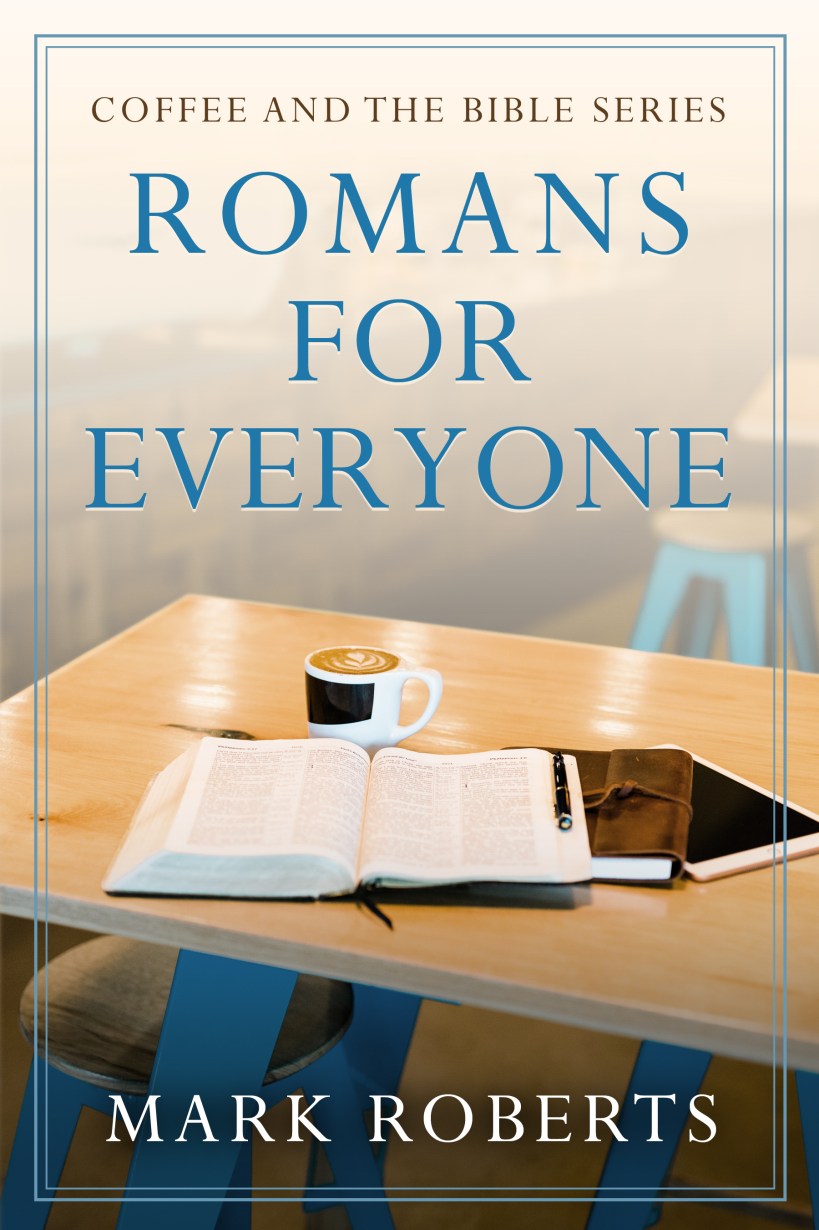
New Book On Romans

Romans For Everyone_EBOOK COVER

Preface By Warren Berkley

My earliest exposure to the book of Romans was probably memorizing the names of New Testament books. As a teenager, there may have been a time when I thought the book of Romans was written by R.L. Whiteside and edited by Moses Lard (two commentary writers in the Restoration Movement). I remember thinking I would never understand the book of Romans. Everybody said it was the most difficult book in the New Testament (perhaps along with Revelation).

Then, in my early years of preaching something happened. I read the book of Romans. While I still got the impression of some difficulty, I could see that with repeated reading and serious study, I might just understand what the book is about.

While verse-by-verse analysis has a place, the slow ponderous and microscopic methods can become an obstacle. Mark Roberts has a rare gift for passion and clarity. While he holds an impressive academic background and experience, he speaks and writes for average people like me. He helps you get your hands on the main idea, without ignoring the details; because the details inform and hold the main idea together.

But what then? Once you have the main idea well in hand, and you see how everything is connected and sequenced for unambiguous conclusions, what then? Application! What does all this mean to me? What do I need to do? How should this change my life? Mark wants his listeners and readers to put truth in their heads and then their lives. The practical implications for life, discipleship, relationships, eternity – that’s all packed into Romans and Mark helps us get it. He shows that this is much more than a dry doctrinal discourse or debate.

This is about what God provides in Christ. It has to do with relationships, attitudes, conduct and all of this directed to heaven. This is an excellent guide for reading the book of Romans. It isn’t a lexicon written for academics, a technical reference book or college text. It is for people who want to read Romans over a cup of coffee and just understand the main idea and make it personal. To God be the glory.

Click Here To Order

Roberts, Mark. Romans for Everyone (Coffee and the Bible Series Book 1) . Lower Lights Publications. Kindle Edition.

Messengers

From Pressing On Magazine, Feb. 2020

Do Messengers Matter?

By Warren E. Berkley, assistant editor

So, the gospel is just about the content, the message, the truth from God about salvation. Right?

Well, there isn’t any question that is primary. But the conduct of the messengers is not irrelevant. The conduct and manner of the messengers can encourage good listening, or utterly undermine a good hearing of the message.

When Paul and his co-workers came to Thessalonica, for instance, what if these messengers had been drunk, half-hearted, rowdy and inarticulate? Would that have mattered? Sure. It would have hindered the faithful and effective delivery of the message.

One of the worst things to happen in preaching is for people to want to hear the truth, but the speaker or messenger exhibits behavior that distracts from that desire. The argument I’m making is affirmed by Paul.

Truth Connection: “For you yourselves know, brothers, that our coming to you was not in vain.  But though we had already suffered and been shamefully treated at Philippi, as you know, we had boldness in our God to declare to you the gospel of God in the midst of much conflict.  For our appeal does not spring from error or impurity or any attempt to deceive,  but just as we have been approved by God to be entrusted with the gospel, so we speak, not to please man, but to please God who tests our hearts.  For we never came with words of flattery, as you know, nor with a pretext for greed—God is witness.  Nor did we seek glory from people, whether from you or from others, though we could have made demands as apostles of Christ. But we were gentle among you, like a nursing mother taking care of her own children. So, being affectionately desirous of you, we were ready to share with you not only the gospel of God but also our own selves, because you had become very dear to us.” 1 Thess. 2:1-8

Humanism

In Isaiah, chapter two, the last verse, may I call attention to this curious statement, that would have no meaning without historical context. Isa. 2:22 – the prophet said, “Stop regarding man, in whose nostrils is breath, for of what account is he?”

So, when you factor in literary context from this section of Isaiah, and the broader historical context of the conditions of the people in Judah in the time of Isaiah – this makes sense as an admonition, really a prohibition.

Instead of trusting God, depending on Him, doing His will and embracing His promises – the people had turned away from God to man, to themselves, to their own inventions, devices and resources.

We have a word for that in our post-modern world: HUMANISM. That is no longer a narrow philosophical category or one of many worldviews.

It is the way of the world in our time, to not look to God; to consider Him either non-existent or irrelevant. Then, to put man in His place. To worship man, trust in man, and deceive the next generation into thinking that man has the answers, not God.

The Jewish people in Judah and Jerusalem in Isaiah’s time were trusting in idols, forming political alliances with heathens, turning to fortune tellers and celebrating men who were drunk and women who were worldly.

Humanism marks out the way, from God to exalted but empty human wisdom. Isaiah describes their sin of exalting human wisdom, then calls upon them to stop it.

“Stop regarding man, in whose nostrils is breath, for of what account is he?”

Earlier in Isaiah chapter two, the people are warned. Back in verse 17 – “And the haughtiness of man shall be humbled, and the lofty pride of men shall be brought low, and the Lord alone will be exalted in that day.”

This should ring true for us today, as we approach the year 2021. Humanism isn’t just a school of thought peddled by atheists. It isn’t just a footnote in a philosophy class. It is becoming a way of life, acclaimed, in some cases enforced as law and imposed on our children.

We must not let who God is slip from our hearts. In Isa. 45:5, the Lord of Hosts declares, “I am the Lord, and there is no other; besides me, there is no God…,”  

Three Dollar worth please

This is the way D.A. Carson begins his commentary on Philippians. He is asking us to imagine a rather crass approach. He makes the point well through this bold imagery.

“I would like to buy about three dollars worth of gospel, please. Not too much—just enough to make me happy, but not so much that I get addicted. I don’t want so much gospel that I learn to really hate covetousness and lust. I certainly don’t want so much that I start to love my enemies, cherish self-denial, and contemplate missionary service in some alien culture. I want ecstasy, not repentance; I want transcendence, not transformation. I would like to be cherished by some nice, forgiving, broad-minded people, but I myself don’t want to love those from different races—especially if they smell. I would like enough gospel to make my family secure and my children well behaved, but not so much that I find my ambitions redirected or my giving too greatly enlarged. I would like about three dollars worth of gospel, please. Of course, none of us is so crass as to put it that way.”

SOURCE: Carson, D. A.. Basics for Believers: An Exposition of Philippians. Baker Publishing Group. Kindle Edition.

Full of Grace & Truth

There was a man sent from God, whose name was John. He came as a witness, to bear witness about the light, that all might believe through him. He was not the light, but came to bear witness about the light. The true light, which gives light to everyone, was coming into the world. He was in the world, and the world was made through him, yet the world did not know him. He came to his own, and his own people did not receive him.  But to all who did receive him, who believed in his name, he gave the right to become children of God, who were born, not of blood nor of the will of the flesh nor of the will of man, but of God. And the Word became flesh and dwelt among us, and we have seen his glory, glory as of the only Son from the Father, full of grace and truth. – Jno. 1:6-14

John, the writer, offers clarity about another John, the forerunner of Christ. He came as a witness, but He was not the light of the world. Jesus is the true light, offering from God – enlightenment to all men. The darkness of sin doesn’t have to be eternal. Jesus is the true light, and “to all who” believe in His name, “he gave the right to become children of God.” Learn more about that, as you continue through John and then read the book of Acts.

Now there is this pivotal statement in verse 14: “And the Word became flesh and dwelt among us, and we have seen His glory, glory as of the only Son from the Father, full of grace and truth.”

John wants his readers to be clear about this. It is not that Jesus remains in heaven and shines a light down to us. It is not that he stayed home with God and just sent teaching for us to follow. No. “The Word became flesh and dwelt among us.” We use the word “incarnation.” He came here to live a real human life. As it says in Matt. 1:23, “God with us.”

Further, it is not the case that Jesus told us a little truth from God, or that He gave us a peek into the grace of God. He came “full of grace and truth.” Through Jesus, God offers the gift of eternal life and the opportunity to understand and practice the truth. Learn more about this fullness, as you continue through John and the rest of the New Testament.

I want you to meet someone

In the beginning was the Word, and the Word was with God, and the Word was God. He was in the beginning with God. All things are made through Him, and without Him was not anything made that was made. In Him was life, and the life was the light of men. The light shines in the darkness, and the darkness has not overcome it. – John 1:1-5

Without going any further, just here at the end of verse 5, the Bible reader knows who John is talking about. Even if it isn’t fully understood why John uses the term “Word,” we know He is talking about Jesus Christ. Think of it like this. Who was in the beginning? Who was with God? Who is God? The rest of the New Testament answers – Jesus Christ.

Jesus Christ is uncreated, eternal, divine and was active with God in creation. And, should there be any doubt about who John is identifying, verse 14 states clearly – that the Word became flesh and dwelt among us. John begins with these propositions about who Jesus Christ is. It is like he meets visitors in the foyer and says “here is what this place is all about.” Or, a lawyer makes his opening statement: here is what I’m going to prove about Jesus Christ.

It also may occur to the reader – that this New Testament book begins like the first book in the Old Testament. “In the beginning.” But that’s more than just a literary observation. Verse 3 affirms that “all things were made through” Jesus Christ. It is entirely in keeping with Bible truth to describe Jesus Christ as the “Creator.” He is so designated in Hebrews chapter one and in Colossians chapter one.

Another Genesis one connection. We are familiar with the historical truth that God said, “let there be light, and there was light.” That was physical light. John says that Jesus is the light of men. Sin puts the sinner in the dark. Jesus became flesh, lived and died and was raised – so that we can get out of the dark.

The illumination man needs to see hope and see God is – THE WORD, who became flesh, and who is later described in John as “the light of the world.” After this prologue, John brings witnesses to the stand and offers solid historical evidence, that can lead the reader to faith and the activity of faith.

Gratitude has Benefits

Are You Enjoying The Benefits Of Gratitude?

1 Thessalonians 5:18

“Gratitude,” said G. K. Chesterton, “is the mother of all virtues.”

Higher authorities echo the vital role of gratitude: “…in everything give thanks,” (1 Thess. 5:18) and “enter His gates with thanksgiving,” (Psa. 100:4).

Gratitude does at least three good things. When directed to God, it places the glory where it should be, in Him. “He who glories, let him glory in the Lord,” (see 1 Cor. 1:31; Psa. 7:17; Psa. 92:1-2). In the absence of sincere gratitude to God, one can gradually slip into an ugly moral spiral (Rom. 1:21). “A true Christian is a man who never for a moment forgets what God has done for him in Christ, and whose whole comportment and whole activity have their root in the sentiment of gratitude.” (John Baillie)

Further, gratitude is good for our emotional health. The habit of grumbling and complaining comes from and further fuels an inner bitterness that can make you miserable. It is hard to get an angry outburst from a grateful heart filled with joy and praise. “Thankfulness is the air conditioner of the soul. It blows out the stale overheated air and brings cool refreshing breezes to the soul,” (Phil Pringle).

Third, gratitude encourages the people you thank. Thankfulness causes the recipient to spend a moment knowing they have contributed some good to others. You are honoring good people and telling them they matter. Paul is anxious to express his thanks to the Christians in Philippi (Phil. 1:3), Rome (Rom. 1:8), but he also told the troubled church at Corinth, he was thankful to God for them (1 Cor. 1:4).

I challenge you to fuller participation in gratitude. The benefits are great.

Paraphrase Driven By Emotion

If your enemy is hungry, give him food to eat;
    if he is thirsty, give him water to drink.
 In doing this, you will heap burning coals on his head,
    and the Lord will reward you. – Prov. 25:21-22

There was this preacher who was really mad at someone, steaming and ranting to his wife about it. His sweet wife tried to calm him. She said, “my dear. You need to read Prov. 25:21,22.” He snapped back, “I don’t have my Bible handy right now.” She responded, “you know the passage. Quote it.”

He sneered and quickly spoke: “if your enemy is hungry, give him your wife’s worst casserole. If he is thirsty, give him your pharmacist’s worst cough syrup. In doing this you will heap coals on his head and the Lord will reward you.”

Of course, once he got that angry paraphrase out, he calmed down and allowed his wife’s admonition.


Help, Don’t Hurt

therapist comforting patient
Photo by Polina Zimmerman on Pexels.com

Help, Don’t Hurt

So I’m going through Proverbs and in the Hezekiah section, I encounter a statement I honestly do not remember thinking about before.

Prov. 25:20 – “Whoever sings songs to a heavy heart is like one who takes off a garment on a cold day, and like vinegar on soda.”

My first thought, maybe odd. Helping my grandkids with the familiar science experiment, of making a “volcano” with vinegar and baking soda. It’s here in the Bible. I was amused by that.

Of course, that’s not the point. The point in the simile is – two things are like something else. Taking your coat off in cold weather is discomforting. Having vinegar and soda applied to a wound is discomforting.

As I thought about that, I checked some other translations. In the New Living Translation, I found this rendition: “Singing cheerful songs to a person with a heavy heart is like taking someone’s coat in cold weather or pouring vinegar in a wound.”

This is about a mis-guided effort to comfort the grieving.

Singing a merry tune to someone with a heavy heart is like – what? Taking the coat of one who is cold, or applying the vinegar/soda mixture to a wound. It not only doesn’t help. It hurts.

With that thought, my mind starting churning for examples. At a funeral, we generally hear the music of mourning and grief; what is appropriate or fitting. At a military funeral, for example, you will hear TAPS, not Happy Birthday.

Wise people stop and think about what is appropriate in response to grief. We don’t want to irritate, discomfort or sting the heavy heart.

Harold Comer wrote this in Christianity Magazine in 1984.

We (need to) find the right words with empathy. Too often, well-meaning spiritual people bull into another’s life. They tell them exactly what they should do without any awareness of the other’s emotional condition or mood. They not only fail in their effort to help, they come through as insensitive, pushy bores and they close doors for later help. God commanded a spirit of empathy in Romans 12:15 and 1 Corinthians 12:26. Wise men don’t sing songs to the heavy-hearted (Proverbs 25:20). Identify their mood. Be sympathetic. Then speak gentle words to help find receptive ears.[1]

[1] Comer, H. V. (1984). The Right Word. (B. Lewis, Ed.)Christianity Magazine, 1(7), 12.