Generosity Prov. 3:27,28

Come Back Tomorrow?

(Prov. 3:27,28)

Warren E. Berkley

“Do not withhold good from those to whom it is due, when it is in the power of your hand to do it. Do not say to your neighbor, ‘Go, and come back, and tomorrow I will give it,’ when you have it with you,” (Prov. 3:27,28, NKJ).

This is a call to generosity but it is written as a prohibition (“do not”). Here’s a little “secret” of good Bible study: When you read a prohibition, spend some of your study time focusing on the opposite. So when you read, “do not lie,” think of the value of honesty. When you come to “do not forget” God’s law (Prov. 3:1), consider how important it is to remember God’s law. Every prohibition has some positive opposite. The point of the prohibition is not only to keep us from sin, but to take us to that positive opposite.

In this case, “do not withhold good” is a call to generosity, sharing, benevolence. Whatever we have that is subject to sharing, we should be willing to give with those “to whom it is due.” Generosity combined with wise stewardship is all over Scripture.

The hard part of this is figuring out “to whom it is due,” or (NIV), “those who deserve it.” To give profusely to undeserving recipients is apparently not wise (Matt. 7:6). But it is often not clear. Seems that the line between deserving and undeserving is not always easy to discern. But I would say to us these things:

1. God doesn’t expect us to see everything He is able to see. God can look right through the externals to the internal motives, and God has in His perfect mind – Instant Background Checks on everybody. God knows that we have no such powers. So there is no expectation that we have perfect knowledge of every prospective recipient of our goodwill. We can only act on what we are able to know.

2. Never cancel a duty because exaggerated qualifications. Could be, we become so obsessed with the qualification (“those who deserve it”) we just cancel the duty, thinking the work is too imprecise or demanding. Generosity (as directed by God) involves the hard work of wisdom, discernment, good stewardship and prayer; that’s part of the sacrifice of giving. Good responses to God and people are never subject to human anger, whim, greed or emotion.

3. Don’t let your experience with the undeserving lead you to deny the deserving. Most of us have heard people say something like, “I gave this guy some help, and he turned out to be a thief. So I just don’t help people anymore.” That’s reactionary, creates suffering for the deserving and puts you squarely against the will of God. Your experience should never be the basis of your generosity. The basis of all giving is, you are a recipient of God’s grace and responsible to obey Him.

Patience and Energy

Isaiah 40:28–31 · Mark 1:35 · Luke 22:43 · Matthew 11:28–29

I didn’t catch his name.

Several weeks back I was in line at Burger King getting my coffee — the large, the same one I get every morning — and the young man behind the counter rang me up. I asked how he was doing. He said good. Said he was working a sixteen-hour shift.

I said, how do you do that?

He said, patience and energy.

And I walked back to my office with those two words and I have not been able to put them down since.

We treat patience like a sedative and energy like a stimulant — as if the goal is to calibrate the dose. Some of us are built to endure. We wait, we don’t spiral, we outlast things. But the drive is low. Others burn through at a rate that leaves patience in the dust. So we manage the deficit and call the arrangement maturity.

That young man didn’t say that. He put them together like they belonged together.

I think he was right.

Isaiah had seen something like this before. Not in a fast food joint, but in exile — in a people wrung out by Babylon, who had been waiting so long they had started to wonder if waiting was all there was. The prophet’s answer did not promise the exile would end on their schedule. It promised something else:

“Have you not known? Have you not heard? The LORD is the everlasting God, the Creator of the ends of the earth. He does not faint or grow weary; his understanding is unsearchable. He gives power to the faint, and to him who has no might he increases strength. Even youths shall faint and be weary, and young men shall fall exhausted but they who wait for the Lord shall renew their strength; they shall mount up with wings like eagles; they shall run and not be weary; they shall walk and not faint.” — Isaiah 40:28–31, ESV

The waiting is the mechanism of the energy. Not a prelude to it. The same transaction. And we have been trying to reverse it — most of us — running first and then wondering why there is nothing left for the long walk home.

I keep reflecting on that phrase — the same transaction. Because that’s what we don’t believe. We believe they’re sequential. First you build up the patience, then the energy arrives as the reward. Or first you burn through the energy, and then patience is what you practice while you recover. Either way, one feeds and the other follows. But Isaiah doesn’t describe a sequence. He describes a God who does not faint handing endurance to people who do — and the handing happens in the waiting, not after it. Maybe that’s why we keep running out. We’ve separated what was never meant to come apart.

But the point isn’t the theory. The point is that someone lived it.

Jesus understood this from inside a human frame that could actually be exhausted. Mark records what he did the morning after a day full of synagogue and crowds and healings, the whole town gathered at the door after sundown:

“And rising very early in the morning, while it was still dark, he departed and went out to a desolate place, and there he prayed.” — Mark 1:35, ESV

Before anyone else was moving. Dark. Alone. He was going to where the energy came from.

And in Gethsemane — at the point of maximum cost, the weight of what was coming pressing against the human will of the Son of God in a way no one can easily describe — Luke records what happened:

“And there appeared to him an angel from heaven, strengthening him.”— Luke 22:43, ESV

Not removing the cup. Strengthening him for the carrying of it. He received it the same way he always had — in prayer, in contact with the Father. Don’t expect to see an angel. But the God who strengthened him has already spoken to what he will do for us:

“fear not, for I am with you; be not dismayed, for I am your God; I will strengthen you, I will help you, I will uphold you with my righteous right hand.” — Isaiah 41:10, ESV

Same God. Same promise. Different side of the cross — and a better one.

Patience and energy. In that order.

The question is not whether you have enough of either one. Most of us already know we don’t. The question is whether you know the way back to where they come from — and whether you will go there before the running out, not after.

“Come to me, all who labor and are heavy laden, and I will give you rest. Take my yoke upon you, and learn from me, for I am gentle and lowly in heart, and you will find rest for your souls.”— Matthew 11:28–29, ESV

The rest he is offering is not the absence of the sixteen-hour shift. It is a different source for what the shift requires.

I didn’t catch his name. He had no idea he was describing something ancient, something the prophets named, something the Son of God modeled on his knees in the dark before sunrise.

But here is what he could not tell me — what only the text can say:

Where are you going when both run dry?

Scripture Chain: Isaiah 40:28–31 → Mark 1:35 → Luke 22:43 → Matthew 11:28–29

Herb Berkley

The Real Christ Today

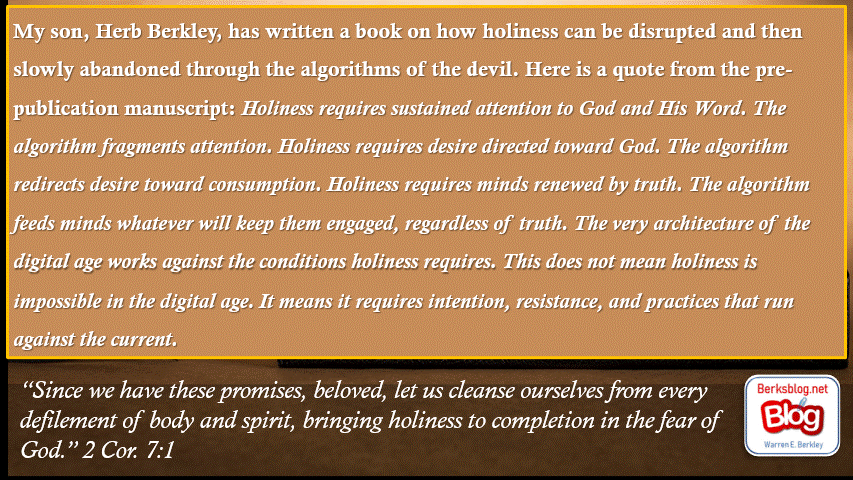
“Remember your leaders, those who spoke to you the word of God. Consider the outcome of their way of life, and imitate their faith. Jesus Christ is the same yesterday and today and forever. Do not be led away by diverse and strange teachings” (Hebrews 13:7–9, ESV).

The flow is deliberate: remember the leaders who taught faithfully, observe how they lived and died, imitate their faith. And then the declaration: Jesus Christ is the same. And then the warning: do not be led away by strange teachings. The unchanging Christ is the antidote to doctrinal drift. The leaders who taught faithfully were teaching about a Christ who does not change. The faith we are called to imitate was faith in a stable Savior. And the strange teachings that would lead us away are strange precisely because they present a different Christ—a Christ who has updated, evolved, progressed beyond what the apostles taught.

The church in every generation faces this pressure. New teachings arise that claim to represent an advance, a development, a more enlightened understanding. They present themselves as progress. But the test is straightforward: Is this the same Christ?

Is this the faith once for all delivered to the saints? Is this consistent with what was taught from the beginning? If Christ is the same yesterday, today, and forever, then the teachings that were true yesterday remain true today. The doctrines do not expire, the ethics do not evolve, and the gospel does not require updating. What the apostles delivered is what the church must guard, not because the church is backward, but because the Christ it proclaims is unchanging.

-Herb Berkley, quoted from his pre-publication manuscript of a book soon to be released. We will post when the book is released.

The Stranger’s Map

The Stranger’s Map

Psalm 119:17–20

“Deal bountifully with your servant, that I may live and keep your word. Open my eyes, that I may behold wondrous things out of your law. I am a sojourner on the earth; hide not your commandments from me. My soul is consumed with longing for your rules at all times.”

(Psalm 119:17–20, ESV)

Most of us have never thought of ourselves as foreign. We have addresses, routines, doctors who know our names — all the furniture of belonging.

The psalmist had a different read on that.

I am a sojourner on the earth. Not as metaphor. Not as a devotional way of saying life is hard. As a precise legal category: the resident alien — someone who cannot own the land, cannot settle the way citizens can. The psalmist applies this status to himself, not as poetry. We are not owners here. The land belongs to Someone else.

I have read Psalm 119 for years, and if I am honest, the longing in verse 20 always felt like something I was supposed to imitate rather than something I actually recognized. My soul is consumed with longing for your rules at all times. The word underneath consumed carries the sense of being ground down — a sustained, grinding want. For years I felt a more comfortable version — the rules as customs I observed, not navigation I needed.

What changed — and this is the thing I have been working through — is the sojourner frame in verse 19. When the psalmist says hide not your commandments from me, he is not asking for access to religious instruction. He is asking for what a foreigner desperately needs: the rules that explain how to live in a place you were not born into. The commandments are the map the alien carries. Not a cage. The only orientation the displaced person has.

The depth of the longing is tied to how clearly we feel the displacement. When this world feels like home — when the routines have settled into permanence — the commandments feel like optional enhancement. But we can confess the sojourner identity on Sunday and live as settlers the rest of the week. We accumulate. We invest — and not just financially. We plant ourselves into the rhythms of this present age as though the lease will never expire. The displacement is affirmed as doctrine and forgotten as experience. The commandments drift back into customs. The longing cools. The map gets filed away.

He wrote: “Beloved, I urge you as sojourners and exiles, abstain from the passions of the flesh that wage war against your soul” (1 Peter 2:11, ESV). The abstain is grounded in the identity. You cannot consistently resist what belongs to this world if this world is home.

This thread runs older than Peter. The writer of Hebrews says the patriarchs “died in faith, not having received the things promised, but having seen them and greeted them from afar, and having acknowledged that they were strangers and exiles on the earth” (Hebrews 11:13, ESV). That verse keeps returning to me. They greeted the promises from afar. They did not hold them. And the acknowledgment — it is not their burden to escape. It is the posture that made the faith possible.

We are strangers here. That is the orientation.

The commandments, the rules, the wondrous things the psalmist asks to behold in verse 18 — these are not burdens loaded on us at the border. They are what God gives to a person displaced by design, in a country they were never meant to stay in.

My soul is consumed with longing.

Mine has not always been.

Whether ours is probably depends on how clearly we feel where we are.

HEB