
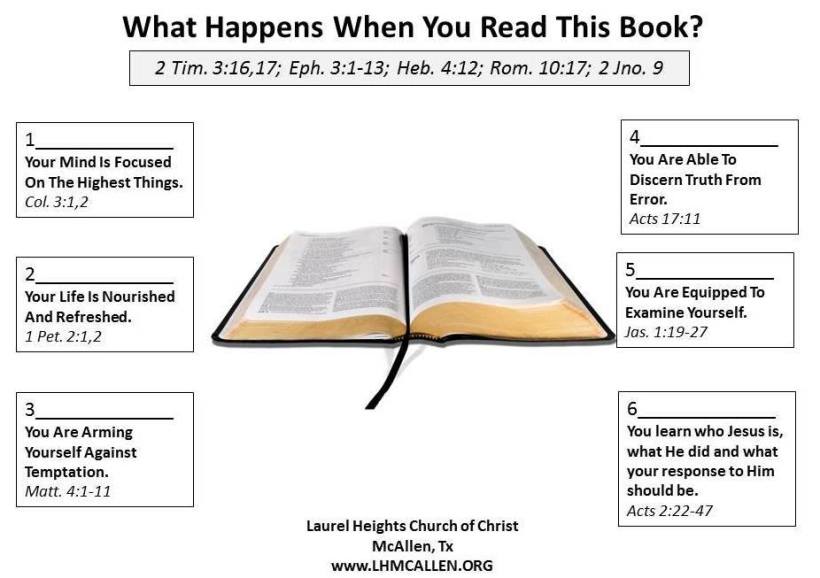
When You Read The Book
The Essential Glory of the Son of God, 1:1-5.
The incarnation and general reception of the Son of God, 1:6-18.
The revelation of the Son of God to Israel, 1:19-12:50.
The revelation of the Son of God to the Disciples, chs. 13-17.
The glorification of the Son of God in his Passion, chs. 18-19.
The manifestation of the Son of God in resurrection power and glory, chs. 20-21.

“Count it all joy, my brothers, when you meet trials of various kinds.” – Jas. 1:2
One way to look at this is, James is teaching us how to count. Just look at the word “count” in this verse. Perhaps you think of accounting. That’s close. The word means “to reckon,” consider or look at the whole picture.
A good accountant doesn’t just look at one line or figure. The whole picture is considered or reckoned.
We need to account for our lives as we would keep books for a business. Take everything into account. A single event doesn’t have to create permanent depression. A single day or even year may be packed with “trials,” but when the whole picture of your life with God is considered, joy remains the over-riding perception. James teaches us how to count, how to consider trials as events that do not diminish the joy of living in Christ.
While that is true, the inspired writer goes further. Read from a variety of translations, the reader is taken deeper.
NIV: “Consider it pure joy, my brothers, whenever you face trials of many kinds.”
NTPE (New Testament in Plain English): “My brothers and sisters, you should be very happy when you experience many kinds of trouble.”
Private Translations of Ralph Martin: “Treat it as altogether an occasion for joy, my brothers, when you meet trials of various kinds.”
Beyond just holding to a general joy, James says to count it all joy “when you meet trials of various kinds,” or in the trial itself. Two levels of instruction are presented here. (1) Maintain an overall joy as one living in Christ. But deeper there is (2) the challenge of being joyful in the trial.
For Christians, the trial itself can be a joy. How can that be?
Keep Reading
“Knowing that the testing of your faith produces patience.”
This is knowledge. Knowledge that God has so arranged the life of His people, when our faith is tested, there is a promise that patience is produced as we endure the trial.
There is something good God’s people can anticipate in every kind of trial. As we go through it with enduring faith, we develop patience. Patience is developed in the ordeal. God has set it up that way for His people.
James teaches us how to count. The whole picture creates joy. And even in the trial, good outcome is promised to the faithful.
“We see that advantages are not in themselves the guarantee of success.
Saul had many, yet he failed ingloriously. We dare not lean on them.
We see also that wonderful opportunities do not in themselves crown
men. Nor even do special spiritual equipment immunize us from the
possibility of getting out of the will of God, and ‘playing the fool’.”
Baxter went on to describe this matter of “playing the fool.”
He said …
– “A man plays the fool when he neglects his best friends,
as Saul neglected Samuel…
– A man plays the fool “when he goes on enterprises for God
before God sends him, as Saul did.”
– A man plays the fool “when he disobeys God” in what he
considers to be “small matters.”
– A man plays the fool “when he tries to cover up disobedience
by a religious excuse.”
– A man plays the fool “when he allows jealousy and hate to
master and enslave him, as Saul did.”
“Oh, what warnings this man utters to us.”
I will add – May God help us give heed to these
warnings.

I was writing class material the other day for my Proverbs class when something came up I wanted to write about here. Look at this in Proverbs chapter three:
27 Do not withhold good from those to whom it is due,
when it is in your power to do it.28 Do not say to your neighbor, “Go, and come again,
tomorrow I will give it”—when you have it with you.
29 Do not plan evil against your neighbor,
who dwells trustingly beside you.
30 Do not contend with a man for no reason,
when he has done you no harm.
31 Do not envy a man of violence
and do not choose any of his ways,
32 for the devious person is an abomination to the Lord,
but the upright are in his confidence.
I made this point. We may have an ingrained and perhaps exaggerated hold on personal liberty. There is that voice we may hear in our heads or from others: Nobody will tell me I can’t do this!!
Yet in moments of calm sanity, we know that legitimate prohibitions are for our safety, good order in society and life. There is the Stop Sign. That is a prohibition. Don’t keep going. Stop. We understand the value of that prohibitions.
The Word of God contains many prohibitions. God isn’t keeping us from anything we need or should be entitled to! The prohibitions in His Word are for our good, our spiritual safety and the good of others – all to His glory.
My Youtube Channel is also a platform for lessons in Proverbs. Click Here.
1 My son, do not forget my teaching,
but let your heart keep my commandments,
2 for length of days and years of life and peace they will add to you.
3 Let not steadfast love and faithfulness forsake you;
bind them around your neck;
write them on the tablet of your heart.
4 So you will find favor and good success in the sight of God and man.
5 Trust in the Lord with all your heart, and do not lean on your own understanding.
6 In all your ways acknowledge him, and he will make straight your paths.
7 Be not wise in your own eyes; fear the Lord, and turn away from evil.8 It will be healing to your flesh and refreshment to your bones.
Let me address that last verse. Verse 8 needs some attention as we begin.
If you just read verse 8 – without context – and some do – your impression might be that this is a promise of physical health.
Against that impression, there is context. What is this about? The context clearly reflects that this is about spiritual health. By “spiritual health” I mean – your relationship with God.
Look through the paragraph and you’ll see it. What words and phrases do you see: “teaching, commandments, steadfast love, finding favor with God, trusting the Lord, walking in straight paths, fearing the Lord and turning away from evil.” What does the context indicate? Spiritual health. So the imagery in verse 8 isn’t a promise of perfect physical health. It is figurative language suggestive of the spiritual health of our relationship with God.
All right – that answered – what are we told to do to insure good spiritual health, a fit and vigorous relationship with God?
To be receivers of what the Gracious God of heaven offers – what must I do?
Look back into this paragraph. “…do not forget” the teaching. Let your heart “keep” His “commandments.” The length of days isn’t time on earth, it is time with God (that through Christ can extend into eternity).
So, if I want a strong, healthy relationship with God, I must “let not steadfast love and faithfulness forsake” me. Write the words of God on my heart; that’s internal journaling.
“Trust in the Lord will all your heart.” Do not “lean on your own understanding.” “In all your ways acknowledge Him, and he will make straight your paths.” Carefully avoid arrogance, “fear the Lord and turn away from evil.”
The result of these responses to God? A good, long-term relationship with God that is healthy, strong and perfectly beneficial.
Where do you put your hope and trust when you get a bad report from the doctor? How do you get some control of the situation? Author Phyllis Ten Elshof says that, when battling the fear of recurrent breast cancer, she first tried to find comfort in statistics:
“You’re gonna be okay,” whispered the lady in pink as she wheeled me down the hall. “Eighty percent of breast lumps aren’t cancer.”I stifled a sigh. So far, statistics had not been in my favor. My breast lump, which was big enough to be seen by the naked eye, hadn’t shown up on a mammogram. Mammograms are effective only 80 percent of the time.
Via https://www.preachingtoday.com/illustrations/2006/october/7100206.html
First, the prosperity gospel is found nowhere in the Bible. The prosperity gospel is coldhearted materialism in religious disguise. It chooses Bible verses selectively to fit a name-it-and-claim-it theory, but it does not love God. It wants to use God for selfish, infantile purposes. Where does the prosperity gospel say, as the gospel clearly says in Philippians 3:7–11 (I will paraphrase it), “I have lost everything, and I’m cool with that, because I’ve gained Christ. I have been stripped bare. I have nothing left. All I have is Christ, and I’m happy, because he loves me, and that satisfies my heart”? That is the gospel, and that is true prosperity.
Ortlund Jr., Raymond C. . Proverbs . Crossway. Kindle Edition.
“Draw near to God and He will draw near to you.” – James 4:8

