Success

From a biblical view, success has more to do with who you are becoming than with what you have accomplished. In our culture, we typically tie success to finances and accomplishments. God, however, connects success to obedience and character.

God is more focused on us growing in Christ-likeness and using our gifts and talents effectively for His purposes.

Source

Wisdom Speaks: Life Lessons from Proverbs

Tim Riordan

Spiritually Healthy Reactions

close up of paper against black background
Photo by John-Mark Smith on Pexels.com

Spiritually Healthy Reactions Bring Hope

Warren E. Berkley

“In this you greatly rejoice, though now for a little while, if need be, you have been grieved by various trails, that the genuineness of your faith, being much more precious than gold that perishes, though it is tested by fire, may be found to praise, honor, and glory at the revelation of Jesus Christ,” (1 Pet. 1:6,7). “He indeed was foreordained before the foundation of the world, but was manifest in these last times for you who through Him believe in God, who raised Him from the dead and gave Him glory, so that your faith and hope are in God,” (1 Pet. 1:20,21).

The Christians Peter addressed were “grieved by various trials.” We take this to be a specific reference to the persecution they suffered (see 3:17), but here’s the fact: Christians suffered and the causes varied (see Jas. 1:2).

When people become Christians, God doesn’t transport them into a perfect little bubble where nothing unpleasant ever happens again. While this idea is popular and desirable, it just isn’t true. Read about the people who spread the gospel in the book of Acts. They were very good people who suffered some very bad treatment. Study the life of Paul. No perfect bubble. Then consider all the teachings of the New Testament telling Christians how to think of suffering and how to respond to it (Rom. 5:2-5; Jas. 1:2-4, etc.). The fact is, some very harsh realities (often without explanation of origin) hit very good people.

As soon as we discover we are suffering, we must quickly turn our focus to spiritually healthy reactions. Training in faith and character we receive early in life or early in our journey as Christians should put us in position to resist the typical reactions of depression, bitter complaining, lashing out at people and walking away from God.

The same training that enables us to resist unwise reactions should prompt us to become well engaged in spiritually healthy reactions: prayer, contact with good people, reflection on relevant passages of Scripture and activity that (to the best of our ability and knowledge) addresses the problem. Participation in these good reactions is not wasted energy. Learning to suffer is not about finding answers, it is about finding hope when you don’t have answers.

I love it!

close up of human hand
Photo by Pixabay on Pexels.com

I love it.

  • I love the sidewalk and driveway art in my neighborhood and the creative work I’m seeing posted on social media.
  • I love it that our Pharmacist pulled me aside and said, “next time, call first and we will bring the RX out to your car.”
  • I love church members who are cooperative, compliant with safety precautions, checking on each other, logging into live streams, downloading resources and being so generous in gratitude.
  • I love it when I have to stand in a line and someone (with poor vision?) thinks I’m elderly and invites me to the head of the line. “Come on in the store sir, we are open for senior citizens first.”
  • I love my kids who check on us frequently and “lay down the law about what they want us to do or not do.”
  • I love it when my next-door neighbor yells from his driveway, “we have plenty of potatoes if you need any.”
  • I love it when my other next-door neighbor speaks to me from her yard about how she had groceries delivered. She wanted me to know we could do it too. She gave me the phone number.
  • I love Zoom, Facebook Live, Google Drive, Email, Pandora, WordPress, T-mobile. I even love Spectrum.
  • I love my preacher friends who are generous in helping older preachers learn online technology.
  • I love my older preacher friends who are doing their best to use what they learn.
  • I love my wife who cooks, manages the budget and house and is just here, sometimes in my office just keeping me company.
  • I love my Facebook friends who encourage me by posting valuable ways they are using their time home.
  • I love what I believe will happen – What we learn in a crisis we will use after the crisis.
  • I love God, His Son and the Holy Spirit – Who richly provide the way for me to look beyond earthly crisis to heavenly celebration.

One Day

I recently read one of Dee Bowman’s recent books. You need to get this, no matter your age. THE JOY OF GROWING OLD IN CHRIST. Click Here To Order.

On pages 82 & 83, there is a valuable seed to plant in your mind.

ONE DAY…
… What you own won’t make any difference.
… What you did and whom you impressed won’t make any difference.
… Who you knew won’t make any difference.
… What awards and rewards you received won’t make any difference.
…Whether you were beautiful or handsome won’t make any difference.
… Who you knew, where you went, what you did, how much fun you had, won’t make any difference.

ONE DAY …
… What you gave to others will make a difference (James 4:17).
… What others learned from you will make a difference (Matthew 28:18-20).
… When and where you shined your light will make a difference (Matthew 5:32).
… What kind of love you gave will make a difference (Matt. 22:37).
… What kind of preparations you have made for judgment will make a difference (Hebrews 9:27).


Don’t be a fool

man taking a selfie with a drunk man
Photo by Pressmaster on Pexels.com

Mr. Fool

I’m doing some teaching and podcasts from Proverbs and early in the book, you get to meet Mr. Fool (sometimes he is married to Mrs. Fool). While there are several kinds of fools described in the book, there is a common attribute that is punctuated in the opening chapter. “Fools despise wisdom and instruction,” (1:7).

This is the opposite of the fear of the Lord. “The fear of the Lord is the beginning of knowledge.”

In Proverbs, there is this “fool,” who acts on impulse, without discipline, WHO DOESN’T CARES ABOUT WHAT IS RIGHT or MORAL or OBEDIENT TO GOD. Nor does he have a good mature grasp of how choices and consequences are connected.

There is a key word here.  “Despise.”

Have you ever tried to talk some sense into somebody – and they just hate it; can’t stand it; don’t want any part of good sense. They have a contempt for the truth. They would rather go away, smoke a cigarette and get a beer – than listen to wisdom. That seems to be basic to this imagery of the fool, though foolishness may express itself in a variety of ways.

So, right on page one of Proverbs, it is this simple: Don’t be a fool.


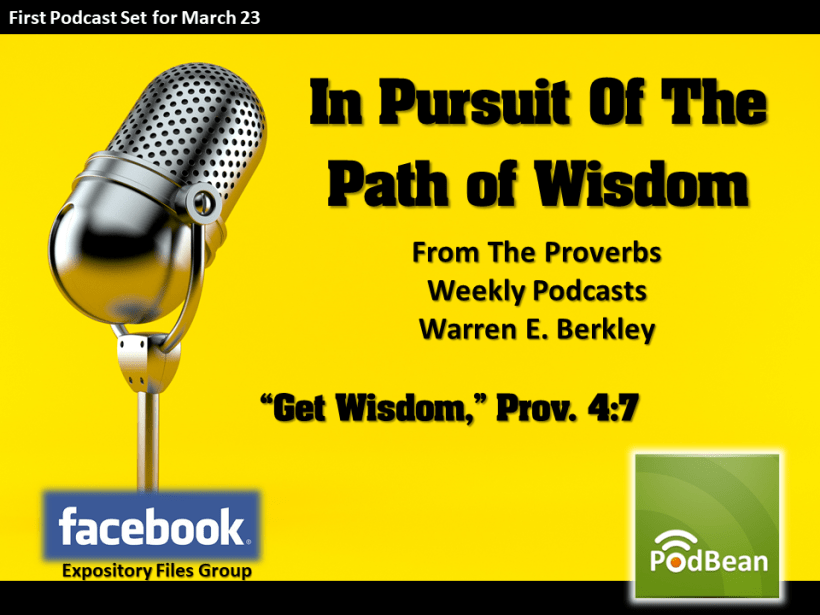
1st Podcast – Proverbs

Proverbs PodcastsIn Pursuit of Wisdom

Proverbs Podcasts 2020

Warren E. Berkley

[Listen Here]

Welcome to these podcasts I’ll be posting at least once a week, and the subject will be – the Old Testament book of Proverbs.

What a treasure house of insight into life. Not just navigating life on earth with wisdom. Life in response to God, respectful of His will and boundaries. Warnings about moral crashes; simple statements of understanding about so many things pertinent to a good life on earth – and a good relationship with God.

Let’s begin here: In the Bible – Old Testament and New – there is a rich variety of types of writing.

In the New Testament – The biographical material about Jesus, in Matthew, Mark, Luke and John. The historical narrative of the spread of the gospel in Acts. The letters or epistles. The final book – Revelation is its’ own kind of writing.

In the Old Testament – Books of History, Books of Law. Prophetic Writing. The Psalms. Wisdom literature like Ecclesiastes and Proverbs.

So, let me do a simple comparison. If you are in First and Second Thessalonians. The apostle Paul wrote these two letters to Christians in Thessalonica. In many ways, it is very much like a letter – an initial greeting, encouragement, instruction and warning suited to their needs. Those epistles read like letters; they are letters and follow that genre or form of communication.

Proverbs is not that kind of writing.

In most cultures throughout history – this has been and continues to be a common form of instruction and communication. I’m going to give you a little test. (I’m not going to be able to hear your response.) Think about it.

I’m going to begin a sentence and ask you to finish it.

Curiosity killed the ________ (cat).

Rome was not built in a ____ (day).

Let bygones be _______________ (bygones).

Those are proverbs or sayings we are familiar with – used to express some knowledge or make an observation, in a brief but memorable form. Sometimes these simply reflect experience, not objective truth. But the design is to be memorable and repeatable.

An essay, narrative or discourse is different. Proverbs are brief nuggets of wisdom, that put the spotlight on some truth we need from God.

Mike Wilson, in his book, said, “The Biblical Proverbs are God’s text messages – little, bite-sized packages of wisdom often delivered in a memorable, witty manner.”

There are places in the book of Proverbs where some extended discussion is placed. In chapter one and two, then some narrative scenes later in the book.

But in the main – we will be studying snapshots, God’s text messages.

We will be in pursuit of wisdom from God, communicated mostly in brief sayings.

As you read through Proverbs and listen to these podcasts, you’ll see all these familiar topics and relationships.

Commitment to God.

Listening to your parents.

Attitude.

Money.

Temptation.

Friendship.

A lot about the use of the tongue.

            (In modern application, the

            keyboard.)

Warnings about sexual temptation.

Responsibility.

The godly woman, the godly man.

I’ve named only some of the many topics we encounter in Proverbs. Remember, we are not talking about long discourses or essays or something like the epistles.

These are brief sayings, easy to commit to memory – containing wisdom from God. They are calling our names, inviting attention and reminding us of how we should be thinking, speaking, acting and reacting.

Listen to the opening:

 The proverbs of Solomon, son of David, king of Israel:

2 To know wisdom and instruction,
    to understand words of insight,
3 to receive instruction in wise dealing,
    in righteousness, justice, and equity;
4 to give prudence to the simple,
    knowledge and discretion to the youth—
5 Let the wise hear and increase in learning,
    and the one who understands obtain guidance,
6 to understand a proverb and a saying,
    the words of the wise and their riddles.

7 The fear of the Lord is the beginning of knowledge;
    fools despise wisdom and instruction.

What is “the fear of the Lord.” I’ll cover that in the next podcast.