Friendship (Thanks Bill Fairchild)

From Walking In Sunlight, by Bill Fairchild

“And Elijah said to Elisha, ‘Please stay here, for the Lord has sent me as far as Bethel.’ But Elisha said, ‘As the Lord lives, and as you yourself live, I will not leave you.’ So they went down to Bethel.” (2 Kings 2:2)

In every aspect of our lives, we are engaged in friendships on multiple levels.

We are cautioned to avoid “friendship with the world” (James 4:4).  We are encouraged to choose well those with whom we associate because they can help us to grow, mature and become more Christlike, thus helping us on our journey to be prepared for eternity!

I’m not sure we always appreciate the value and the place of each friendship we are introduced to!  If we are not careful, if we are living life way too fast, we can pass right by someone who can really make a difference in our lives!

Jewelry stores are beautiful and expensive places to walk into.  Everything is so sparkly and shiny, displayed in such a way as to catch one’s eyes.  Unless you already have your mind made up on what you are looking for, it can prove to be a daunting experience.

Looking at all the precious stones, their shape, beauty and quality, we find ourselves having to narrow down the search before purchasing or simply walking out to find yet another store to walk into.

Friends are like those precious stones that we have already considered, thought about deeply and made them our own.  Each stone in the jewelry box at home bears its own unique marks and appearance.  Granted we might can find ourselves appreciating and liking one particular set or individual piece … but we are happy to open the lid and see them as ours.

It has been said that true and lasting friendship is rare … and that is an accurate statement, isn’t it?  There are those who are friends … and then there are those who are friends in a much deeper sense.

What a blessing it is to have both categories of friends and friendships.  Yet, we understand the deeper we are able to go with our friendship based on trust and loyalty … the stronger the bond, respect and mutual love!  I thank my God for every one of those who are my friends!

We know the difference don’t we.  The kind of friend that is mindful of our needs … who is careful to speak truth in a way that builds us up rather than tearing us down … who is willing to listen to our words with attention … and who genuinely has our best interest at heart!

I want to be a friend like Elisha was to Elijah.  Elijah was about to leave this world, borne up in a chariot of fire pulled by horses of fire, and Elisha would accept the mantel and become a great prophet in his own right.

I am convinced that one of the qualities that would set him apart from others was his ability to be loyal and trustworthy, and to genuinely care about Elijah.  Don’t we all long for this kind of friendship where we can be honest with one another, even bare our souls and express our doubts and concerns with confidence in the one who hears our words?

Well guess what?  We can, if we are willing to invest in the lives of others!  It has often been said that “we can’t change people’s hearts until they know we genuinely care!”  I want to be like Elisha and I am mindful of those times and occasions when I didn’t measure up to who I needed to be, and I am sorry!

We cannot afford to forget this truth:  To have one as our friend means we must step up to the plate and be a friend for them as well.  It is truly a two-way street!

Friendship is a relationship that is entered into by individuals.  Each friendship is only as good or as close as those individuals decide to commit to make it!  May we never become guilty of taking a valued friendship for granted!  Life is just too short!

“Oil and perfume make the heart glad, and the sweetness of a friend comes from their earnest counsel.”  (Proverbs 27:9)

Bill Fairchild, Jr.

http://walkinginsunlight.com/to-be-a-friend-like-this/?fbclid=IwAR2BweiP2UxJYEvQQJ2eL17ZZX4XW9VSb5t6WbzaMu46QNDhYwgIc0dys9A

Alcohol Lied To Me

Much of what I post on this blog, I found. I guess I’m just a good finder; better at finding than creating. I’m a long-time believer than alcohol – as a recreational or even occasional beverage – has built-in life issues. This piece couldn’t be sourced (author unknown), but reminded me of the life issues.

Alcohol Always Lied to Me

I Drank for Courage…and woke up night after night horrified.

I Drank for Sophistication…and became crude.

I Drank to find Peace…and ignited a war within myself.

I Drank to be Friendly…and became argumentative and nasty.

I Drank to be Sexy…and turned people off.

I Drank so that I could Relate to Others…and I babbled.

I Drank to put down Loneliness…and found myself retreating more into my shell.

I Drank to Relax…and woke up tense.

I Drank to be Entertaining…and became an obnoxious clown.

I Drank to Live More Fully…and contemplated suicide.

I Drank for Adventure…and discovered disaster.

I Drank to be more Honest…and insulted my friends.

I Drank to Quiet my Nerves…and woke up with hangover jangles.

I Drank to Feel Better…and ended up sick and throwing up.

I Drank to have Fun…and passed out in the middle of the party.

I Drank to Pep Myself Up…and ended up exhausted.

I Drank to feel Successful and a Big Shot…but ended up a failure.

I Drank for Security…and became afraid of my shadow.

I Drank to Feel Better about Myself…and ended up hating me.

I Drank to prove I could handle Alcohol…and ended up knowing it controlled me.

* A Friend asked…”But surely, now that you’ve been sober awhile, it would take a lot of alcohol to put you back in that condition.” “Just One Drink,” I answered!

— Author Unknown

Location of this find: http://www.usaprn.org/reflections/alcohol-always-lied-to-me.html


Psalm 107 (repeated)

Warren E. Berkley

Psalm 107:23-32

Some went down to the sea in ships,
    doing business on the great waters;
24 they saw the deeds of the Lord,
    his wondrous works in the deep.
25 For he commanded and raised the stormy wind,
    which lifted up the waves of the sea.
26 They mounted up to heaven; they went down to the depths;
    their courage melted away in their evil plight;
27 they reeled and staggered like drunken men
    and were at their wits’ end.
28 Then they cried to the Lord in their trouble,
    and he delivered them from their distress.
29 He made the storm be still,
    and the waves of the sea were hushed.
30 Then they were glad that the waters[b] were quiet,
    and he brought them to their desired haven.
31 Let them thank the Lord for his steadfast love,
    for his wondrous works to the children of man!
32 Let them extol him in the congregation of the people,
    and praise him in the assembly of the elders.

The 107th Psalm is a piece that centers on praise to the Lord, containing examples of deliverance: cases where men failed; men could provide no redemption. Only God could help. Now, I am not certain of any specific historical context for this. It is generally taken as great promise, for believers who suffer perils of the sea. The ancient mariner faced a high measure of risk and uncertainty and mystery, navigating the sea.

Of course, this was before the navigational technology we enjoy. Yet still today, with all our navigational tools and instruments and radar, we often hear of tragedies on the sea or in the air. (MH370, still not found!)

Think of life as a voyage, that involves the business of danger and risk and unforeseen trouble. Like the ancient mariners – we who follow Christ – have this benefit, this discipline; something God has given, we can do, based on our trust in Him. We are able to talk to the Creator of the seas. We are able to state our case to the One who can still the storm. He can quiet the waters. He can provide the navigational providence – to get us to safe harbor.

Prayer is an effort of will on our part – connecting us to the will of One with infinite power, whose mercy can calm us and steady us. The last verse in this chapter says: “Whoever is wise, let him attend to these things; let them consider the steadfast love of the Lord.”

Be Aware

Awareness Of Danger

Colossians 2:8

“Beware lest anyone cheat you through philosophy and empty deceit, according to the tradition of men, according to the basic principles of the world, and not according to Christ,” [Colossians 2:8].

To beware is to be aware and informed of danger. It means, to take heed and be on your guard, watching for spiritual dangers. Those who walk through life blind, naive and ignorant run into things and get hurt. This verse tells us to be aware. [See also: Eph. 5:15; 1 Pet. 5:8,9; 1 Jno. 4:1.]

Our text says, “Beware, lest anyone cheat you.” The King James says, “Beware lest any man spoil you.” The American Standard, “Take heed lest there shall be anyone that maketh spoil of you.” Notice this word “spoil.” In those days, in a war, captives or prisoners would be taken away. Sometimes they would be paraded before crowds in victory processionals. To be part of the “spoils” of war meant you had been captured, then humiliated, punished and perhaps sold into slavery. This is the picture Paul uses to warn us of what false teachers can do, if we are not careful! [See also: 2 Pet. 2:1-3 & Rom. 16:17,18.] “Beware, lest anyone make spoil of you!”

Notice now the weapons false teachers use to take us captive:

1. Philosophy – a love for some human system of wisdom [1 Tim. 6:20,21; Jer. 10:23.]

2. Empty Deceit. Two ideas emerge from this phrase: {a}that which is deceptive, and {b} that which is empty. When we allow men to deceive is, we wind up with nothing; we are rendered empty by the deceitful teachings and influences of men. [See also: 1 Tim. 2:14; Gal. 6:7-9.]

3. THE TRADITION OF MEN is that which is “of man” and has been handed down from generation to generation. Jesus charged the scribes and Pharisees with this penetrating question: “Why do you transgress the commandment of God because of your tradition?” (Matt. 15:3).

4. THE BASIC PRINCIPLES OF THE WORLD. This probably refers to the old Mosaic law. It was basic, and a necessary step in God’s overall plan. It is called “the elements of the world” in Gal. 4:3, but this law had been annulled and was not to be enforced as necessary to salvation [See, Acts 15:1-35; Gal. 5:1-6].

5. THINGS NOT “ACCORDING TO CHRIST.” If some teaching is “according to Christ,” that means He authorized it; it has His approval. Hence, that which is NOT according to Christ is that which He didn’t authorize; that which does not have His approval. These false teachers, who were attempting to influence the saints at Colossae, were using human philosophy, empty deceit, human tradition, the basic principles of the world and other things which were NOT ACCORDING TO CHRIST.

My friend, don’t be afraid to hold to this conviction –> If something is not according to Christ, we ought not to have any participation in it!! Paul tells us to have no fellowship with the unfruitful works of darkness, but rather reprove them (Eph. 5:11).

We ought not to let anybody convince us that there is something we need for our spiritual welfare, unless it is according to Christ. In Colossians 2:8, the apostle Paul sounds the alarm. Will we give heed??

 By  Warren E. Berkley
From Expository Files 1.3; March, 1994

Visit the EF Archive Site in Canada, Click Here


Pardon Me

Pardon Me!

Romans 5:6-10

I do not like it when the guilty gets away with something; when the governor pardons someone a jury has convicted of a crime, not because the person was found to be innocent but rather because he just did not agree with the sentence.

Or how about this case: I am not making this up; it really happened!

First, the criminal was as guilty as sin. There was no doubt about it.

Second, the judge correctly decides on the appropriate sentence based upon what the many crimes deserved. The sentence was death.

So here we have a felon on death row who deserves to die. There does not seem to be a whole lot wrong with that. Everything is pretty much as it should be. But wait.

The judge has a tender spot for the felon. You see, the felon is also the judge’s son! The son bears a distinct family resemblance, and though his crimes have caused the judge great sorrow, the judge still loves his son. So, guess what.

Even while the son has yet to show any remorse, the judge devises a rather complicated plan whereby the wayward son can live. He allows someone else, one who is not guilty, to step in and pay the penalty for the guilty, and then declares to the guilty, “You’re free to go. I hope this all means something to you and will cause you to think seriously about changing the course of your life, to come back home and start over.”

Yes, it is a true story! God is the Judge and Father, Jesus is the substitute, and the guilty son; well, Th… that, uh…that would be me.

For one will hardly die for a righteous man; though perhaps for a good man someone would dare even to die. But God demonstrates His own love for us, in that while we were yet sinners Christ died for us. Much more then, having been justified by His blood, we shall be saved from the wrath of God through Him. For if while we were enemies, we were reconciled to God through the death of His Son, much more, having been reconciled, we shall be saved by His life. (Romans 5:6-10).

HELPLESS ON DEATH ROW
“For while we were still helpless, at the right time, Christ died for the ungodly.” (Romans 5:6).

Sin is the transgression of God’s law (1 John 3:4). When Adam and Eve ate of the tree forbidden them by the Lord’s commandment, that was a sin. It brought forth the penalty of death. Their bodies were from that hour destined to return to the ground, and they became estranged from God. This means two types of death entered the world, physical as well as spiritual.

Likewise, in our sins we are under the sentence of death. We are on “death row”. The wages of sin is death. We simply await the final execution of sentence; eternal death; separation from God; eternally existing but never living. The Bible calls it hell; the second death (Romans 6:23; Revelation 20:14,15).

So, now we are as “dead men walking”, a term used in our prison systems for those on death row. This well describes us, or as the Holy Spirit put it; “dead in your trespasses and sins, in which you (formerly) walked…” (Ephesians 2:1,2). Is there any hope at all? We certainly cannot realistically provide ourselves with even the smallest measure of hope. There is nothing we can do for ourselves. Our pardon must come from another.

THE MOST POWERFUL DEMONSTRATION OF LOVE

“But God demonstrates His own love for us, in that while we were yet sinners Christ died for us.” (Romans 5:8). What a horrible thing it is to die unprepared because of the consequences sin will have on our eternity. But wait; a pardon has been offered!

In the early 1800’s, President Andrew Jackson offered a pardon to a man named George Wilson (no, not Dennis Mitchell’s next door neighbor) who had been sentenced to death by hanging. Mr. Wilson refused the pardon. Supreme Court justice John Marshall declared, “the value of the pardon depends upon its acceptance. If it is refused, then there is no pardon.” Mr. Mitchell died on the gallows.

In Christ Jesus, God offers us a full pardon. By a complete and overwhelming sacrifice, Jesus paid for our sins so that the pardon could be offered to us by a righteous God. It is up to us to accept it. As Paul and Barnabas said to some who rejected their pardons; “…that the word of God might be spoken to you first; since you repudiate it, and judge yourselves unworthy of eternal life, behold, we are turning to the Gentiles.” (Acts 13:46).

The rejection of the gospel by many does not reduce the amount of love Jesus had for us to take our place. Greater love than Jesus has for us is not possible. But, if we insist on rejecting God’s pardon, then we will die, not as a consequence of the lack of love on God’s part, but because of our own hard-heartedness and self-inflicted blindness.

JUSTIFIED AND SAVED FROM WRATH
“Much more then, having been justified by His blood, we shall be saved from the wrath of God through Him.” (Romans 5:9).

Thank God for His pardon! The blood of another is accounted as payment for my sins. And the result of that is that I am saved from facing the wrath of God at judgment.

So, when can I receive this pardon, already paid for by Jesus? Well, the answer is that the offer remains in place by the patience and mercy of God, and is available to me so long as I am still alive; and that the day of passing sentence has not arrived. But once I leave this world for the next; the offer is withdrawn. Now is the time to receive it!

Some take lightly the Lord’s kindness and mercy. Instead of allowing God’s great patience to lead us to repentance, some abuse it by continuing in sin. The Bible says to those who behave this way, “But because of your stubbornness and unrepentant heart you are storing up wrath for yourself in the day of wrath and revelation of the righteous judgment of God, who will render to every man according to His deeds.” (Romans 2:4-6). The lesson: Please, please do not reject the pardon and be left to face the judgment!

SAVED BY HIS LIFE
” For if while we were enemies, we were reconciled to God through the death of His Son, much more, having been reconciled, we shall be saved by His life.” (Romans 5:10).

We are brought back into harmony with God through the death of Christ. Now, we look forward to victory instead of eternal death. With Paul, we can exult: “Death is swallowed up in victory! Oh death, where is your victory? O death, where is your sting?” (1 Corinthians 15:54,55).

By Jesus’ life, that is, His resurrection to life after His death, by the power of the resurrection, we are saved. Anyone can die, but Jesus lives again! This same power that reconciles us also pardons, or saves us.

But, like Jesus lives a new life, so must we. We become united with Him in the likeness of His resurrection when we obey the gospel, and arise from baptism to walk “in newness of life.” (Romans 6:5). Sin is no longer to be our master; but Jesus is. We receive our pardon of grace by becoming “obedient from the heart to that form of teaching to which you were committed.” This is how to receive God’s pardon and to be freed from sin. (Romans 6:17, 18). Accept God’s pardon and live!
.

By Jon W. Quinn
From Expository Files 5.9; September 1998

A Good Apology

12485831_10154601359074782_4925698965431098676_o

The Elements Of A Good Apology

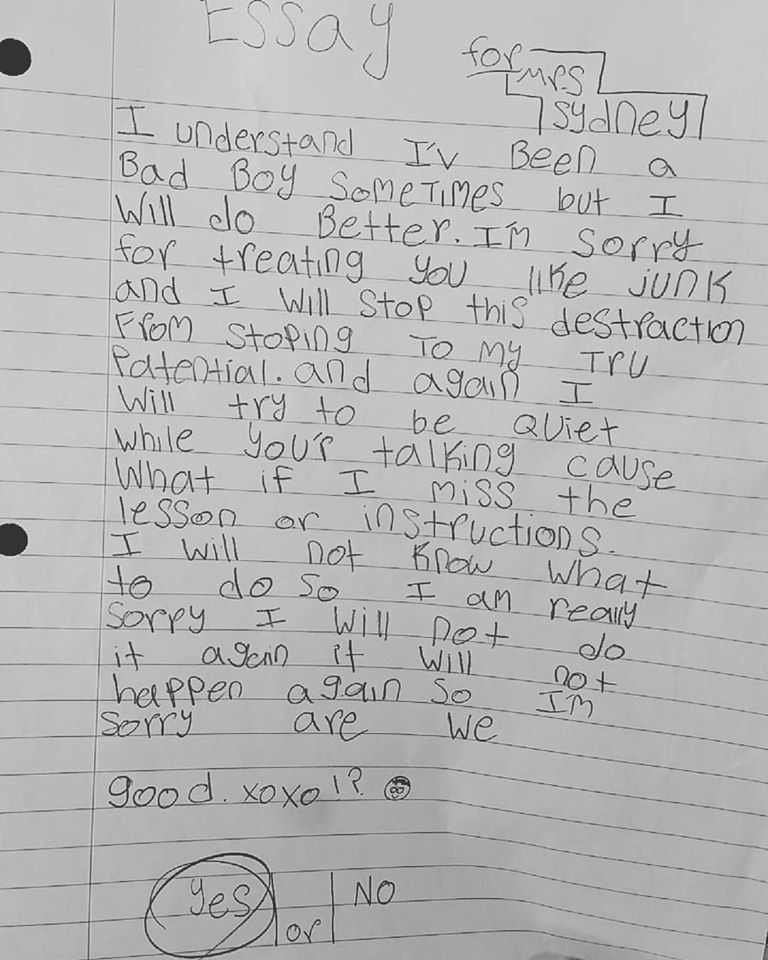
My daughter-in-law who has a career in education (first as a class-room teacher, now a school psychologist) reports to us a variety of experiences that hold our interest. A few years ago, a little boy wrote this essay to “Mrs. Sydney.”

Beyond the entertainment value, a more serious look at this exhibits the elements of a good apology.

  1. He understands he has been bad. An apology needs to be more than just dismissing an awkward event. The one issuing the apology needs to understand the wrong being confessed.
  2. He resolves to “do better.” I wonder how many apologies have been offered without any follow-through or correction? This little boy understands he has been bad and resolves to “do better.” Good for him.
  3. He firms up his resolve: “I will stop.” Stopping bad behavior is clear in his mind and he doesn’t want bad behavior to interfere with his “tru potential.”
  4. He is specific: “I will try to be quiet while you’r talking.” This is no generic, dismissive, impulsive apology. He is specific in his recognition of wrongs.
  5. He acknowledges the need for education and good listening: “…cause what if I miss the lesson or instructions, I will not know what to do…”
  6. Finally, he politely asks for a response: “Good? Yes or No.” Sydney responded.

This little boy teaches Apology 101 right on that page he turned in. There is great hope for him. What about adults?


Before You Eat … consider

Before You Eat, Consider The Heart of Your Host  

Proverbs 23:1-3 & 6-8

A large percentage of the text in Proverbs is printed in sentence format in most editions of English Bibles. There are brief statements that stand alone and convey some aspect of life on earth (example: 19:4), sin in men (20:10) or God’s wisdom for us (21:23). The nature of this kind of literature lends itself to the typical sentence format used by publishers (note the space between most verses as compared to other biblical texts).

There are, however, notable exceptions to this rule. There are some paragraphs in the book of Proverbs, where a theme or teaching goes beyond a single statement (examples: 6:1-5, 9:1-6, 16:10-15). If you will pick up a few different Bibles or translations, you will note the typical sentence format, but the exceptions to that in these paragraphs.

In Proverbs 23 there are two paragraphs which relate to the same matter. Here is Prov. 23:1-3 and under that, verses 6-8. In most Bibles, these passages are printed as paragraphs:

1 When you sit down to eat with a ruler,
Consider carefully what is before you;
2 And put a knife to your throat
If you are a man given to appetite.
3 Do not desire his delicacies,
For they are deceptive food.

6 Do not eat the bread of a miser,
Nor desire his delicacies;
7 For as he thinks in his heart, so is he.
“Eat and drink!” he says to you,
But his heart is not with you.
8 The morsel you have eaten, you will vomit up,
And waste your pleasant words.

Think about the point made in both paragraphs. Solomon is asking us to consider a danger to our character that approaches through an appearance of innocent hospitality and goodwill. A ruler who seeks some advantage over you (verses 1-3), or a miser who also seeks personal advantage (verses 6-8) offers something you like and believe you need (a good meal). The danger is, the “feeder” or host offers this meal, but not with your good in his heart. In the first paragraph, Solomon urges caution: “Consider carefully what is before you.” In the second paragraph, he alerts us to the danger through a direct prohibition: “Do not eat!”

Here is one of many cases where everything seems to be right, innocent, morally neutral and without serious consequence. What wrong could there be in eating a meal with a powerful man, or sharing hospitality with “a miser?” You have to eat? The issue Solomon wants us to consider is – the motive and character of the host, the “feeder.” Apparently the “ruler” in this context has such evil designs, it would be better to “put a knife to your throat” than to let him satisfy your appetite. In the case of the “miser,” the writer says, “his heart is not with you.” The outcome is described in terms of vomiting up the delicacies you consumed. Often in Proverbs we are warned that circumstances and relationships that seem right us can contain hidden moral dangers. (See Proverbs 14:12 & 16:25).

There are two prominent illustrations of this in the Bible, both of these exemplify the right response. Daniel, who “resolved not to defile himself with the royal good and wine,” and our Lord, who though hungry, resisted the devil’s invitation to make bread of stones (Dan. 1:8, Matt. 4:3). Hunger is a legitimate need, but it may be used to our disadvantage. Food can become bait in the hands of the devil and his operatives. My practical response to this is not to refrain from all eating, but to guard myself with care and consider the approach of subtle temptation.

William Arnot wrote a useful book of essays called “Studied In Proverbs: Laws From Heaven For Life On Earth,” (Kregel Publications, 1978). On these passages he said: “When the appetite is strong, and the food enticing, the danger of sinning and suffering is great, – greater than most of us care to observe, and acknowledge to ourselves. The warning here is strongly expressed, and all its strength is needed.”

By Warren E. Berkley
From Expository Files 8.6; June 2001

The Fear of the Lord

 The Fear of the Lord

 Proverbs 1:7

“The fear of the Lord is the beginning of knowledge.”

This is one of the premises forming the foundation of the book of Proverbs (Prov. 1:7, New King James).

Throughout Proverbs and in the Bible at large, God tells us that our basic disposition of mind or attitude is where everything begins. Proverbs 4:23 expresses the same premise: “Keep your heart with all diligence, for out of it spring the issues of life.”

In the New Testament, Jesus echoes this in Matt. 15:18,19 where He shows that sinful behaviors originate in sinful thinking; He specifies adultery, fornication, stealing, dishonesty and blasphemy. He declared that these things come “from the heart.” So in Proverbs, in the teaching of Christ, and throughout Scripture this premise cannot be missed: Our basic disposition of mind or attitude is where everything (good behavior and bad) begins.

Since this is so, there is a practical component I must acknowledge: If I will get my heart right with God, and maintain that disposition of heart, that action on my part will move me in the right direction and prompt good character and behavior. If there is, in my heart, a healthy fear and respect toward God, that is the beginning of a good life of right knowledge and right behavior. “The fear of the Lord is the beginning of knowledge.”

Let’s explore this disposition of heart further. What is the fear of the Lord?

It is not just a feeling of terror, as described in Romans 8:15 (“For you did not receive the spirit of bondage again to fear, but you received the Spirit of adoption by whom we cry out, ‘Abba, Father'”). This is a spirit of bondage that generates fear. This kind of fear is not the beginning of knowledge.

The fear of the Lord isn’t a timid, cowardly spirit, as described in 2 Tim. 1:7. “For God has not given us a spirit of fear, but of power and of love and of a sound mind.” (Note: The word “fear” in the Bible must always be understood in view of the context in which it occurs. You cannot, therefore, assume a single definition or significance that applies “across the board.” You must carefully consider the context in order to assign the proper meaning to the word. It is one of those words that is context sensitive. So, the “fear” we are concerned with in Prov. 1:7 is not identical to the “fear” of Rom. 8:15 or 2 Tim. 1:7.)

In Proverbs 1:7…

The fear of the Lord is an attitude of respect toward God, which includes a healthy dread of displeasing Him. The fear of the Lord is about reverence toward God, respect for Him, love and appreciation, holding Him and His beloved Son in high esteem. And this is the attitude necessary in order for us to know and do what’s right!

So if I want knowledge — I must have this attitude! If I want to know and do what’s right before God; if I want to learn to make ethical and moral distinctions to please God – this attitude must find residence in my heart: The fear of the Lord.

The reason many do not take God’s Word seriously is, they do not have this attitude. They have no foundation of respect for God in their hearts. As a result of the absence of this kind of fear, they read or hear God’s commandments and react: “I don’t want to do that . . . I don’t see anything wrong with this . . . I don’t think I’m going to hell if I do this or neglect that!!” Without the fear of the Lord, there is no reason (in their hearts) to respect Him and obey Him. Faithful service to God and obedience to Christ is rooted in the FEAR OF THE LORD.

Parents need to begin instilling this good influence in their children as soon as influences are possible! Preachers need to preach lessons which are designed to encourage, foster and nurture this fear of the Lord. Elders need to have this fear in their own lives and lead others to this disposition of heart. And when we set about the task of teaching someone what to do to be saved, we need to illustrate, instruct and influence our students in this good direction.

“The fear of the Lord is the beginning of knowledge.”

Throughout the rest of Proverbs, the inspired writer shows that this basic attitude toward God GETS GOOD RESULTS! Notice:

THE FEAR OF THE LORD . .

causes us to depart from evil, Prov. 3:7.
causes us to hate evil, Prov. 8:13.
prolongs our days, Prov. 10:27.
inspired confidence, Prov. 14:26.
affords great contentment, Prov. 15:16.
keeps the heart, Prov. 23:17.
strengthens us against unstable companions, Prov. 24:21.

What is your attitude toward God?

By Warren E. Berkley
From Expository Files 4.9; September 1997

Faith Looks Up

Thanks to my friend, Zeke Flores, who posted this on FB March 5. He’s right.

Many I know of are enduring sorrow of one sort are another. Thinking back about what you lost can be heartbreaking. After all, that’s what sorrow is mostly all about; what’s lost. Then, it can lead to worry about the present and the uncertainty of living in the now. Remember fondly, but don’t let the loss keep you from reaching ahead.
Sorrow looks back. Worry looks around. Faith looks up.

“… fixing our eyes on Jesus, the author and perfecter of our faith, who for the joy set before Him, endured the cross…” – Heb 12:2